

How to Use Moroccan Argan Oil for Curly Hair
ByTASANO
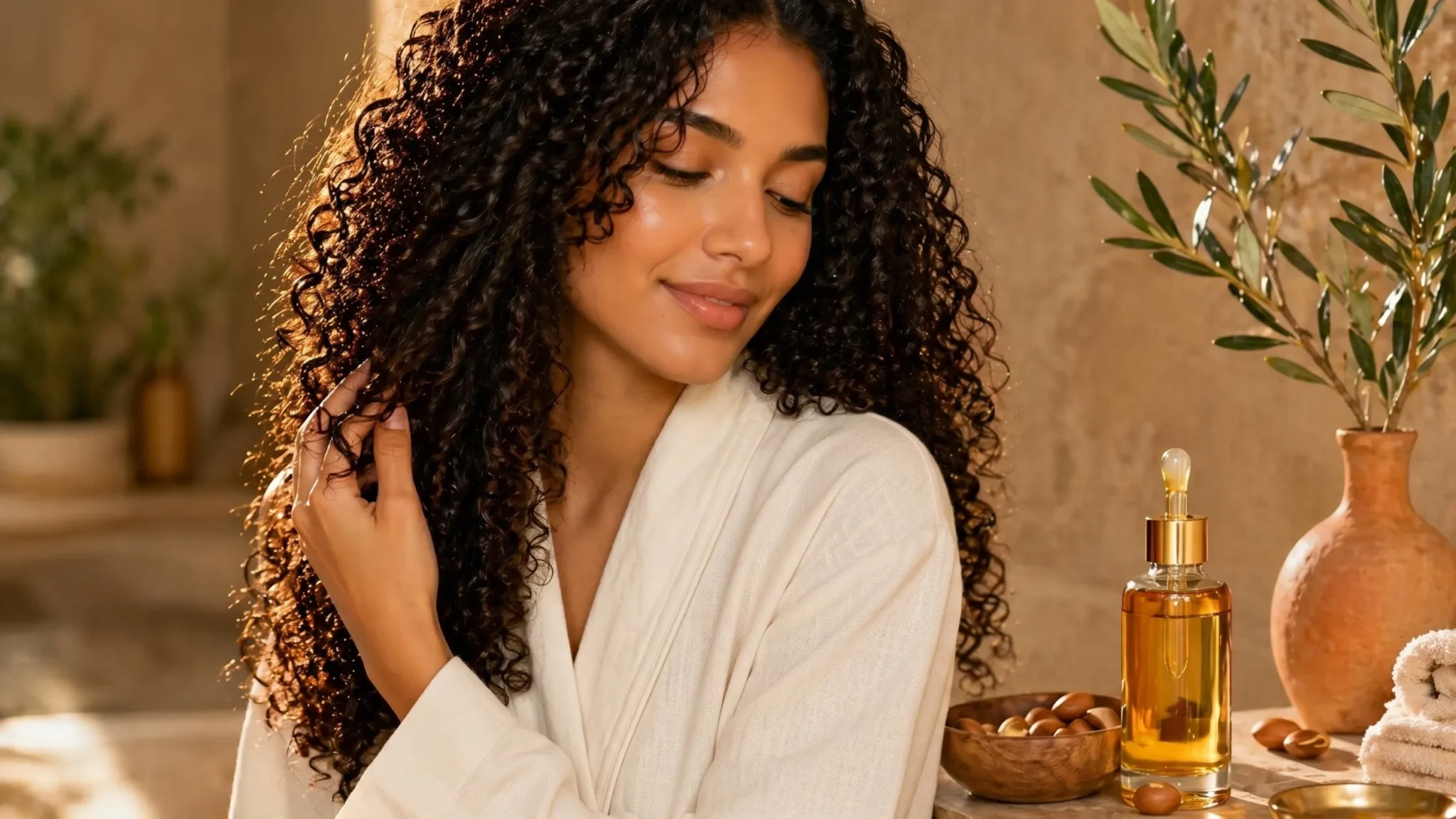
Curly hair does not usually need more weight, it needs the right kind of softness, slip, and frizz control. Argan oil for curly hair can help curls look smoother, shinier, and more defined when it is used correctly and lightly.
One of the main advantages of Argan Oil for Curly Hair is its ability to improve softness without disrupting the natural curl pattern.
The challenge with curls is balance. Curly and coily hair is naturally more prone to dryness and breakage, but heavy products can flatten the curl pattern, create buildup, and make the hair feel coated instead of healthy. Dermatologists at the American Academy of Dermatology note that curly and coily hair is more prone to dryness and breakage, which is why moisturizing routines and gentle handling matter so much.
Argan oil for curly hair works best when it is used as a finishing and smoothing step, not as a heavy coating that buries the curl pattern.
That is where Moroccan argan oil becomes useful. It is not about drowning curls in oil. It is about using a small amount in the right place, at the right time, so curls feel softer, look glossier, and behave better without losing movement.
For a complete view of how argan oil, scalp care, and weekly rituals work together, read Moroccan Hair Care: The Complete Guide to Stronger, Healthier, Shinier Hair.
Table of Contents
Is Argan Oil Good for Curly Hair?
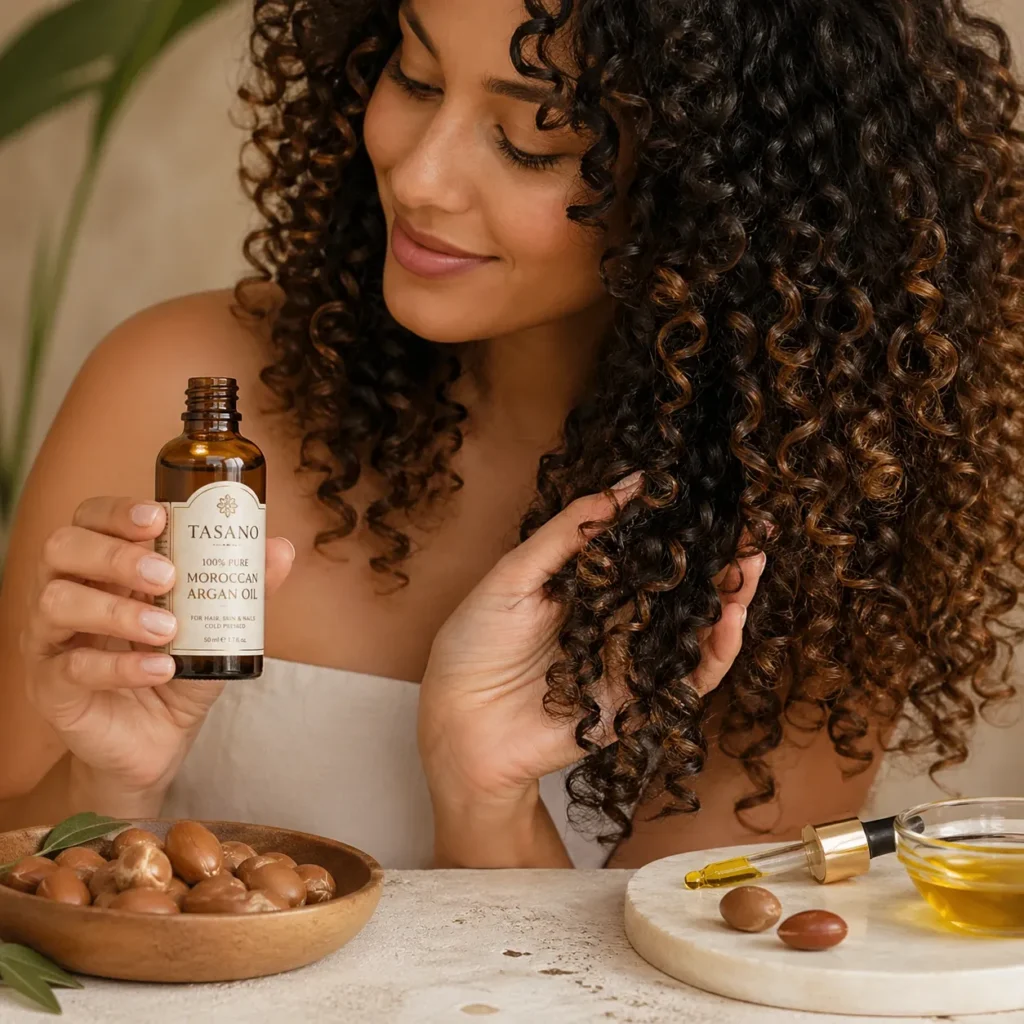
Yes, argan oil is good for curly hair when it is used with control. Its biggest strengths are softness, shine, frizz control, and better manageability, exactly the areas where many curly routines struggle.
Curly hair often feels dry because natural scalp oils have a harder time traveling down the bends and curves of the strand. That can leave the mid-lengths and ends rough, thirsty, and more vulnerable to tangling. Argan oil helps by adding a light nourishing layer that improves slip and smoothness without needing a heavy coating.
The key is application. Argan oil for curly hair works best on the lengths and ends, especially when curls are damp or when the ends need a finishing touch. It is not meant to replace conditioner, curl cream, or a full routine. It is the refining step that helps the routine look more polished.
Argan Oil for Curly Hair is especially useful for curls that feel rough or lose definition by the end of the day.
For the full ingredient breakdown, read Argan Oil for Hair: Benefits, How to Use It and Results to Expect.
Why Curly Hair Needs a Different Oil Strategy
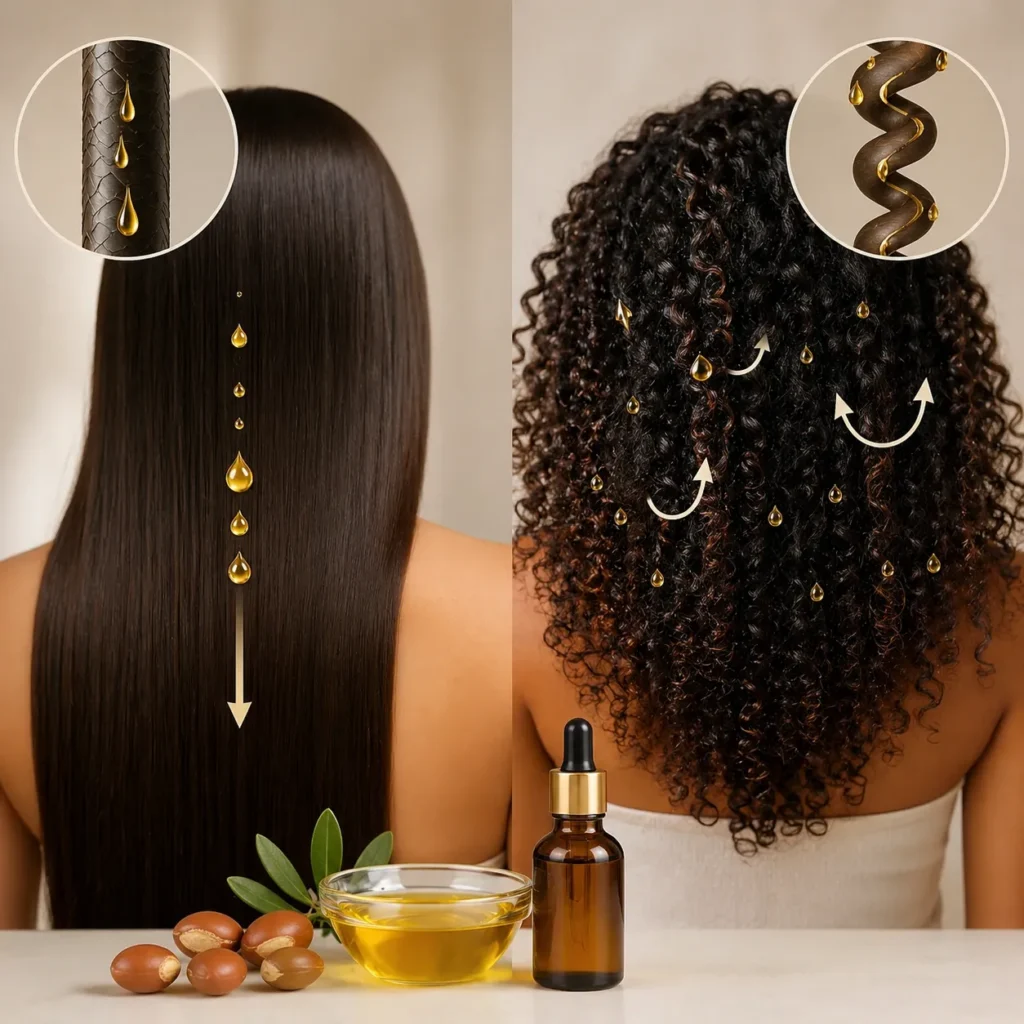
Curly hair is not straight hair with more texture. It behaves differently, dries differently, tangles differently, and breaks differently.
Because of the curl pattern, sebum from the scalp does not spread evenly through the hair shaft. That is why the roots may feel fine while the ends feel dry, rough, or fragile. The AAD also recommends washing curly or coily hair only as needed and keeping it moisturized because frequent washing can leave curls dry, frizzy, and hard to manage.
This is why argan oil for curly hair should be used strategically. Apply it where the hair needs it most: the mid-lengths, ends, frizzy sections, and dry areas. Avoid treating it like a scalp oil unless dryness on the scalp is the specific issue.
Curly hair often struggles with dryness first, which is why understanding how to treat it properly makes a difference. For a deeper approach to dryness and frizz control, read Argan Oil for Dry Hair: How to Use It for Frizz, Shine and Softness.
7 Powerful Ways Argan Oil Helps Curly Hair
1. Helps Reduce Frizz Without Making Curls Stiff
Frizz happens when curly hair is dry, rough, or exposed to humidity and friction. Argan oil helps smooth the surface of the strand so curls look more controlled while still feeling soft.
This matters because many anti-frizz products make curls feel rigid or coated. Argan oil for curly hair gives a more flexible finish. When applied lightly, it helps calm the halo of frizz around the hair without turning curls crunchy or flat.
For the strongest result, apply a small amount of argan oil after your leave-in or curl cream, focusing on the outer layer and ends where frizz usually shows first.
2. Adds Shine to Curls That Look Dull or Tired
Curly hair can look dull even when it is healthy because the bends in the strand scatter light. When the hair surface is also dry or rough, shine becomes even harder to see.
Argan oil helps curls reflect light more beautifully by smoothing the outer surface and adding a refined glossy finish. This is especially useful for dark curls, textured hair, and curls that look matte after drying.
The goal is not oily shine. It is healthy-looking luminosity: curls that catch the light without looking greasy.
3. Makes Detangling Easier and Gentler
Tangling is one of the biggest problems in curly hair care. When curls wrap around each other and the hair surface feels rough, detangling becomes harder and breakage becomes more likely.
Argan oil for curly hair improves slip, which makes it easier for fingers, a wide-tooth comb, or a detangling brush to move through the lengths with less pulling. Hair cosmetics research explains that conditioning and lubrication help reduce friction and improve manageability, which is exactly why a light oil step can make detangling less damaging.
Use argan oil before detangling only in a small amount. Too much can make the hair slippery in the wrong way and cause buildup. The goal is easier movement, not a greasy coating.
Argan Oil for Curly Hair works best when applied in small amounts, focusing on the driest parts of the curls rather than the roots.
4. Softens Dry Ends and Breakage-Prone Areas
The ends of curly hair are usually the oldest and driest part of the strand. They are also the areas most likely to tangle, split, snap, or look rough.
Argan oil for curly hair works beautifully here because it adds softness exactly where curls need it most. A few drops on the ends can make the hair feel more flexible, less brittle, and more finished between wash days.
This is especially useful for curls that look good near the roots but lose definition and softness toward the bottom. Treating the ends separately often gives better results than applying product everywhere.
Argan Oil for Curly Hair can support healthier-looking ends, which are often the weakest part of textured hair.
5. Helps Curls Look More Defined
Definition comes from a combination of moisture, product distribution, and reduced frizz. Argan oil does not “create” curls, but it can help curls clump more smoothly and look less scattered when used correctly.
The best way to support definition is to apply argan oil after your hydrating step, not before. Water-based moisture comes first. Oil comes after to help smooth and finish the curl.
For many curly routines, this means:
- leave-in conditioner first
- curl cream or styling product next
- a few drops of argan oil last
That order helps curls stay soft, glossy, and more controlled.
Understanding how to use argan oil for curly hair correctly makes the difference between defined, polished curls and weighed-down hair.
For the wider Moroccan beauty ingredient world, explore Moroccan Beauty Products: The Complete Guide to Glowing, Clear, and Youthful Skin.
How to Use Argan Oil for Curly Hair
Argan oil for curly hair works best when it supports the routine instead of replacing it. The exact method depends on whether your hair is wet, damp, dry, freshly washed, or between wash days.
The safest rule is simple: hydrate first, style second, oil last. Argan oil for curly hair performs best when it seals and refines the routine instead of replacing moisture.
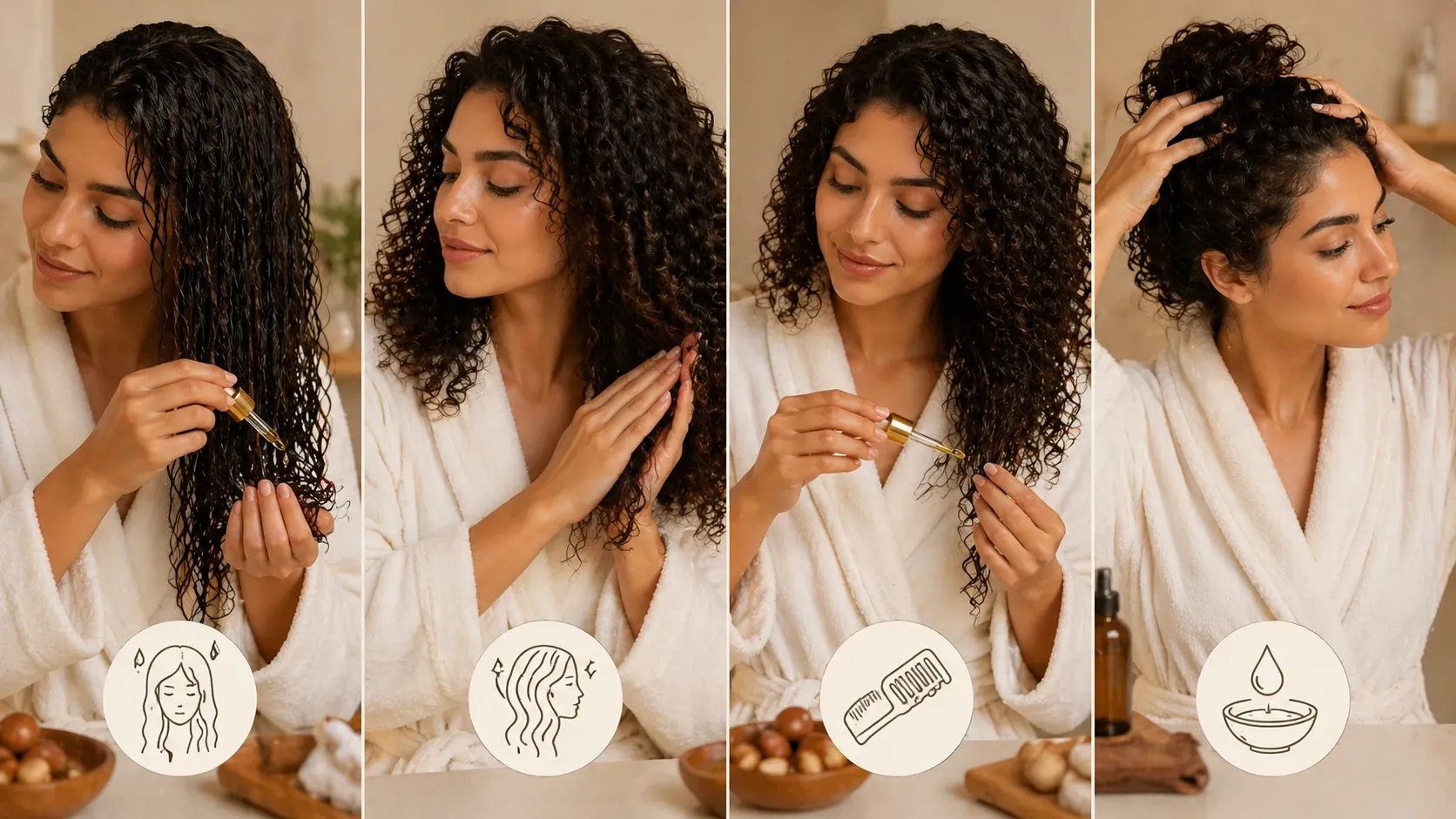
- On damp curls after washing
This is one of the best ways to use argan oil for curly hair.
After washing and conditioning, gently squeeze out excess water with a microfiber towel or soft cotton cloth. Apply your leave-in conditioner or curl cream first. Then warm 1 to 4 drops of argan oil between your palms and smooth it over the mid-lengths and ends.
This method helps seal in softness, reduce frizz, and add shine while curls dry.
For most curls, the best method is leave-in conditioner first, curl cream if needed, then 1 to 4 drops of argan oil smoothed or scrunched into the ends.
- On dry curls as a finishing oil
If your curls look frizzy, dull, or rough after drying, use argan oil as a finishing step.
Rub 1 to 2 drops between your palms, then lightly glide your hands over the outer layer of curls. Focus on frizz-prone areas and dry ends. Avoid raking aggressively through dry curls because that can disturb the curl pattern and create more frizz.
- Before detangling
For curls that tangle easily, use a tiny amount of argan oil to improve slip before gentle detangling. This works best when the hair is damp and already has conditioner or leave-in product.
Do not use oil as your only detangler. Curly hair usually needs moisture first. Argan oil helps the process feel smoother, but it should not replace a proper conditioning step.
- As a pre-wash treatment
For very dry curls, apply argan oil to the lengths and ends before washing. Leave it on for 30 minutes or longer, then shampoo and condition as usual.
Cleveland Clinic’s hair-oiling guidance notes that oils can be applied to the ends and washed out after several hours, and that a little goes a long way.
How Much Argan Oil Should You Use on Curly Hair?
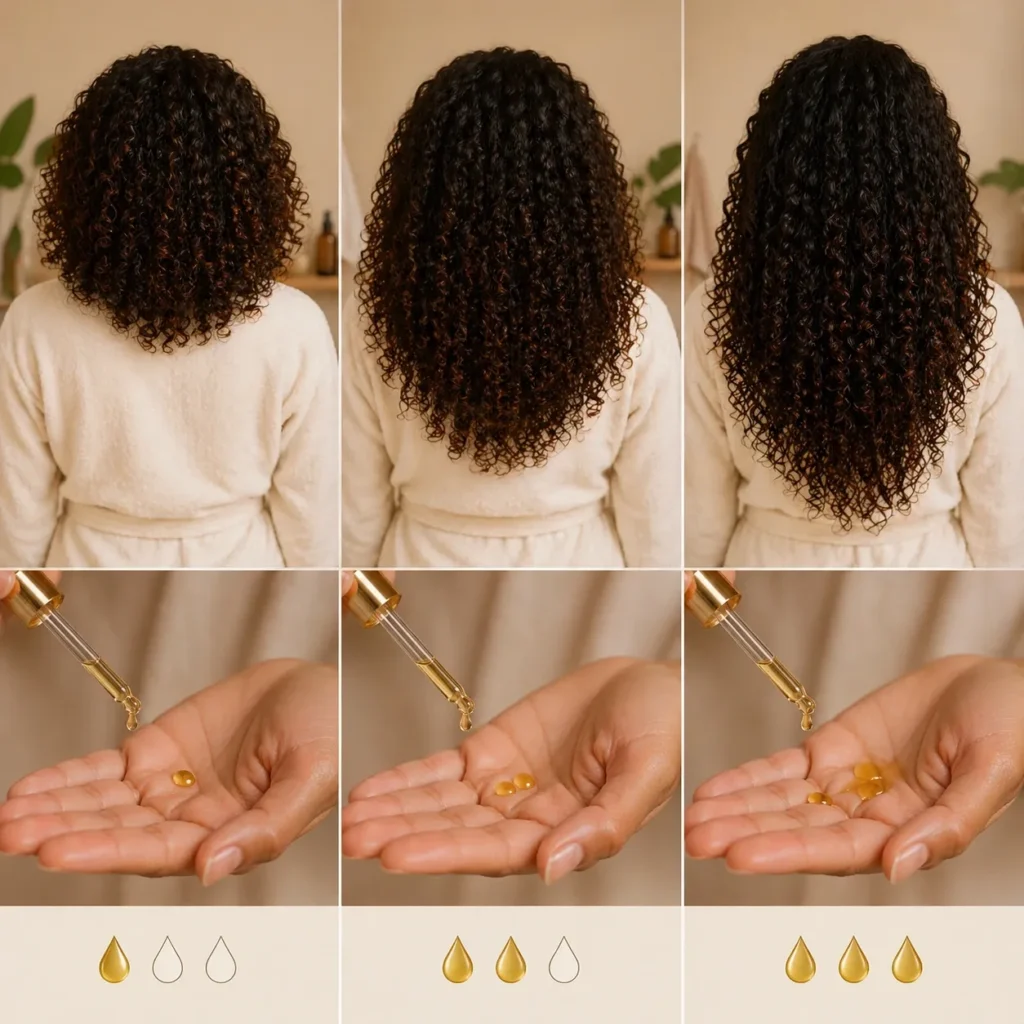
Most curly hair does not need a lot of argan oil. Start small and build only if needed.
A practical starting guide:
- Loose waves: 1 drop
- Loose curls: 1 to 2 drops
- Medium curls: 2 to 4 drops
- Thick curls or coils: 4 to 6 drops, mostly on the ends
- Pre-wash treatment: more can be used because it will be washed out
If the curls look greasy, limp, or separated in a heavy way, you used too much. If they still look dry and rough, add a little more next time.
The correct amount is the amount that makes curls look softer and more polished without stealing their volume.
Best Time to Apply Argan Oil on Curly Hair
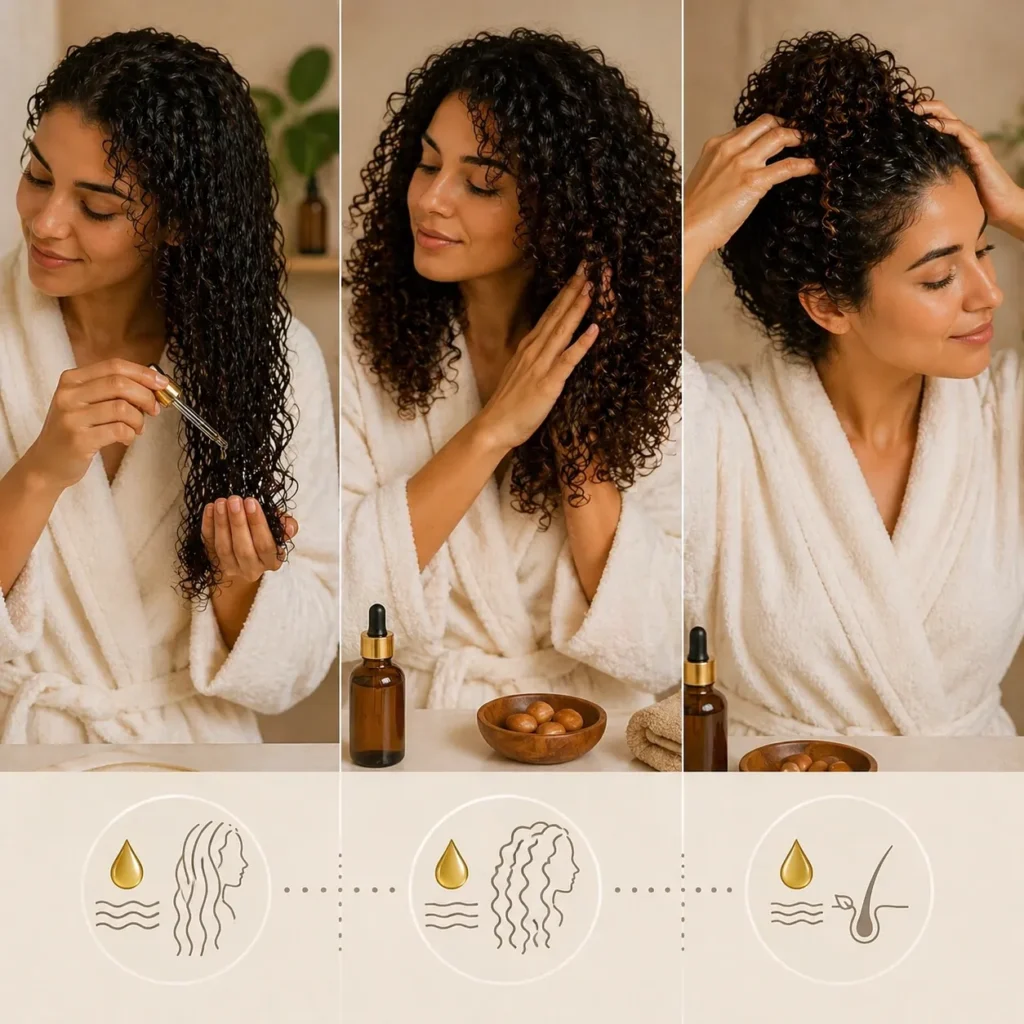
Timing changes the result.
- Apply on damp hair for softness and frizz control
Damp curls are more receptive to styling because the curl pattern is still forming. Applying argan oil for curly hair at this stage helps finish the routine with softness and shine.
- Apply on dry hair for polish and shine
Dry application is best when the curls are already styled but need a smoother finish. Keep it light.
- Apply before washing for deeper nourishment
Pre-wash oiling works well when curls feel very dry, rough, or depleted. It gives the hair a richer treatment without leaving long-term residue.
Argan Oil for Different Curl Types
- Wavy hair
Wavy hair can benefit from argan oil, but it needs the lightest touch. Use 1 drop on the ends only. Too much oil can flatten waves quickly.
- Loose curls
Loose curls usually respond well to argan oil as a finishing step. Use it to soften frizz and add shine after your curl cream or leave-in.
- Tight curls
Tight curls often need more softness and may tolerate slightly more oil. Focus on the ends and dry sections rather than applying evenly everywhere.
- Coily hair
Coily hair is often more prone to dryness and breakage. Argan oil can help reduce roughness and add shine, but it should usually be layered over moisture rather than used alone.
- Color-treated curls
Color-treated curls often feel drier and more fragile. Argan oil can help improve softness and shine while reducing the rough feel that often comes after coloring or chemical processing.
Argan Oil for Curly Hair Routine
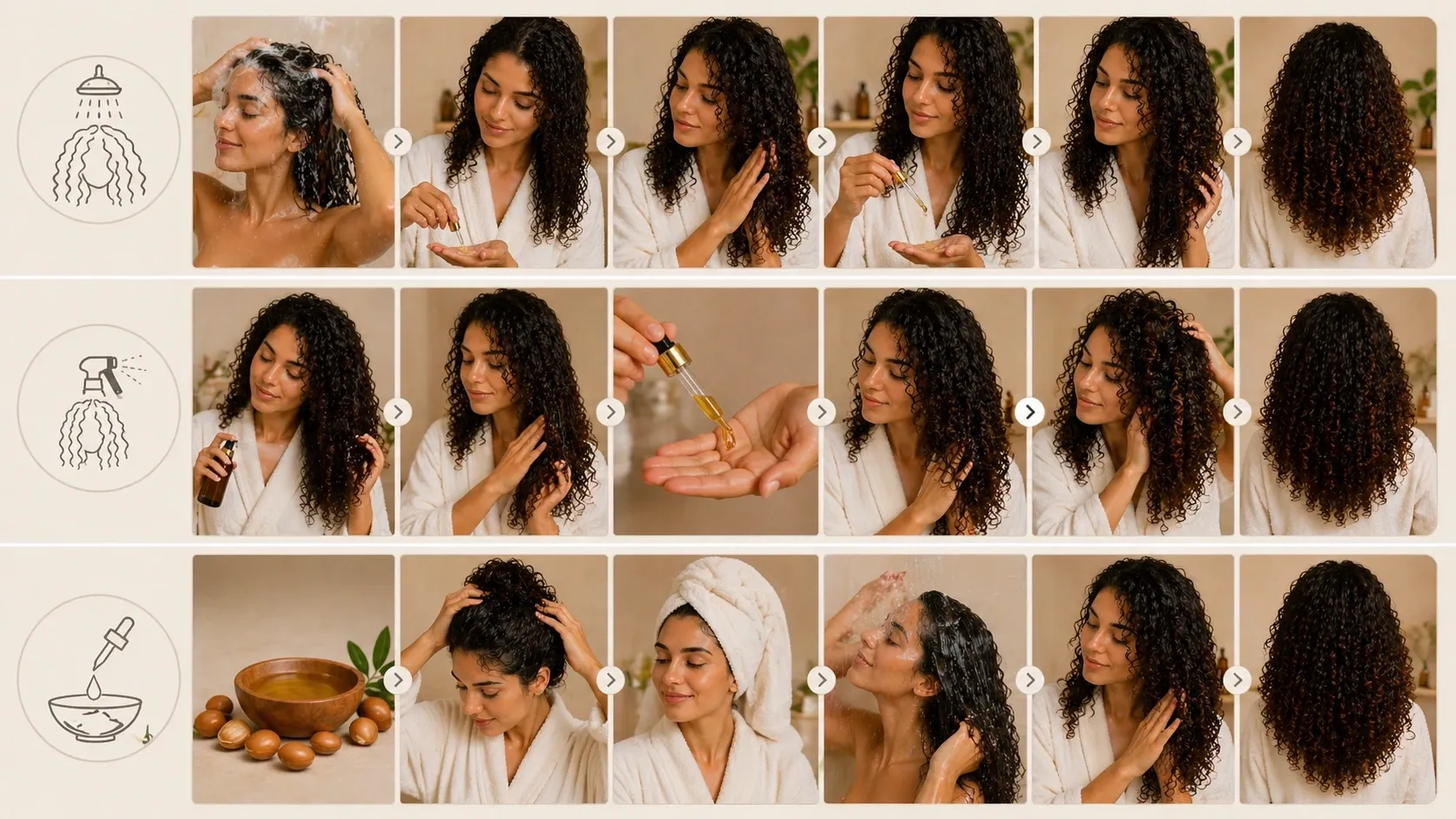
Wash day routine
- Wash only as needed with a moisturizing shampoo.
- Condition thoroughly, focusing on the lengths.
- Detangle gently while hair is conditioned and slippery.
- Apply leave-in conditioner or curl cream.
- Smooth a few drops of argan oil over the mid-lengths and ends.
- Let curls air-dry or diffuse gently.
- Avoid touching curls while they dry to reduce frizz.
The AAD recommends washing curly and coily hair only when needed and keeping it moisturized, because overwashing can leave curls dry, frizzy, and hard to manage.
Refresh day routine
- Lightly mist curls with water if needed.
- Apply a small amount of leave-in product to revive shape.
- Use 1 to 2 drops of argan oil on frizzy or dry sections.
- Smooth gently without breaking curl clumps.
- Leave curls alone once they are shaped.
Weekly treatment routine
- Apply argan oil to dry lengths and ends before washing.
- Leave on for at least 30 minutes.
- Wash and condition as usual.
- Finish with a few drops of argan oil after styling.
For a broader weekly system, read Moroccan Hair Care Routine: Daily and Weekly Routine for Stronger, Healthier Hair.
What Not to Do With Argan Oil on Curly Hair
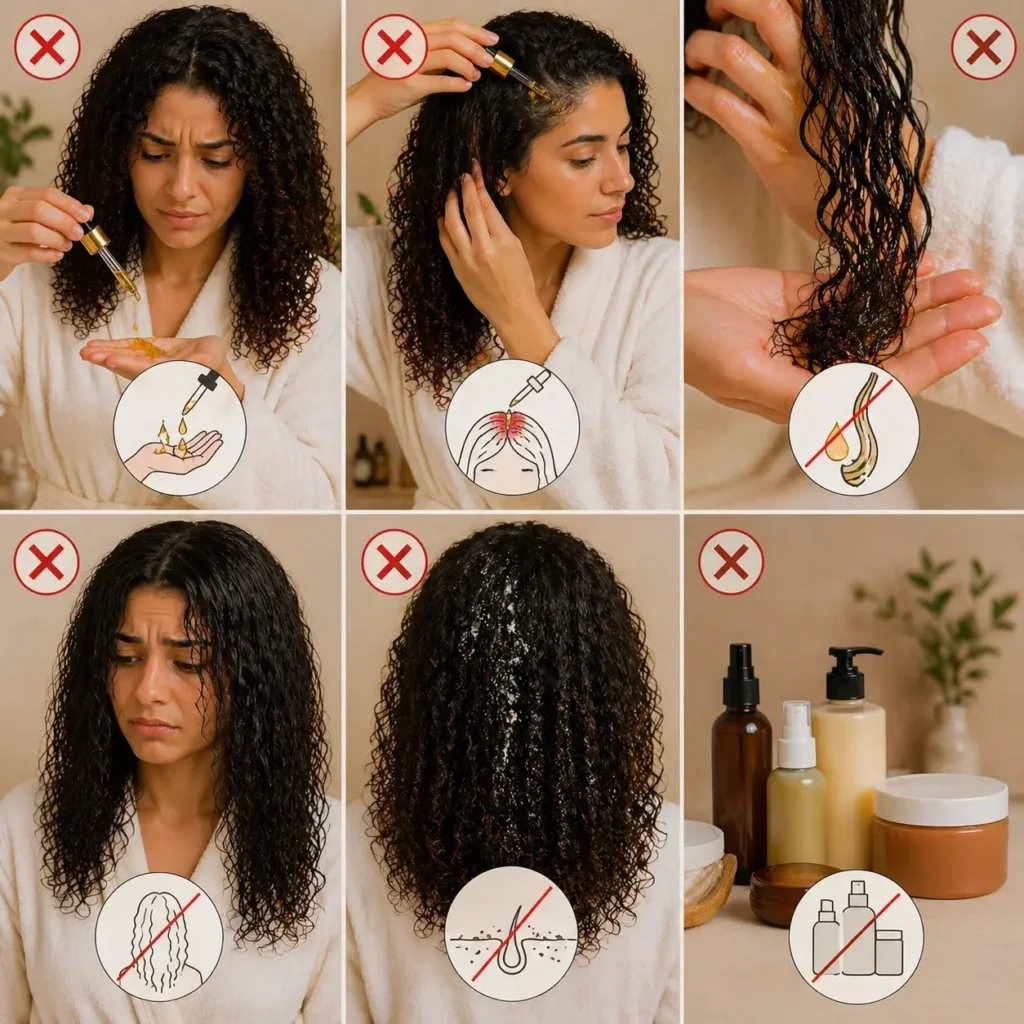
- Do not apply too much oil at the roots
Most curly hair needs argan oil on the lengths and ends, not at the scalp. Roots can become greasy quickly if oil is applied too heavily.
- Do not use oil instead of moisture
Oil helps soften and smooth, but curly hair still needs water-based moisture from conditioner, leave-in products, or curl creams. Using oil alone on dry curls can sometimes seal in dryness instead of fixing it.
- Do not rake through dry curls aggressively
Dry curls lose definition when handled too much. Use a gentle smoothing motion instead.
- Do not use fake “Moroccan oil” blends without checking the label
Some products marketed as Moroccan oil contain only a small amount of argan oil mixed into silicones, fragrance, or other fillers. That may work as a styling serum, but it is not the same as pure argan oil.
To avoid weak formulas, read How to Choose Pure Argan Oil for Hair and Avoid Fake Moroccan Oil Blends.
Can Argan Oil Weigh Down Curly Hair?
If you use too much or apply it too close to the roots, argan oil can weigh down curly hair. This is usually not a problem with the oil itself. It is an application problem.
Argan oil for curly hair should be used in drops, not handfuls. Fine waves may only need one drop on the ends, while thick curls or coils may need a few more. The goal is to soften and polish the curl, not coat it until it loses volume.
If your curls look limp, greasy, separated, or stretched after using oil, reduce the amount and apply it lower on the hair. If your curls still feel dry, layer argan oil over a water-based leave-in instead of using it alone.
Argan Oil for Curly Hair Backed by Better Curl Care
Argan oil for curly hair makes sense because curl care is built around moisture, gentle handling, and reducing breakage. The American Academy of Dermatology notes that curly and coily hair is more prone to dryness and breakage, and recommends washing only as needed, keeping curls moisturized, and protecting hair while sleeping.
Cleveland Clinic explains that hair oiling can help moisturize hair and improve softness when used in small amounts, especially on the ends. Research in PubMed Central on hair cosmetics also supports the role of conditioning and lubrication in reducing friction, improving manageability, and helping hair look smoother. Together, these sources support a practical conclusion: argan oil is useful for curls when it is treated as a light finishing and softening step, not as a heavy replacement for a full curly routine.
Choosing Authentic Argan Oil for Curly Hair
Curly hair is already more vulnerable to dryness, tangles, and buildup, so product quality matters. A vague “Moroccan oil” blend may give temporary shine, but it may not give you the clean, ingredient-led ritual you wanted.
Look for:
- clear ingredient transparency
- pure argan oil or clearly argan-rich formulas
- lightweight texture
- no confusing filler-heavy claims
- proper storage away from heat and direct sunlight
For readers who want confidence in what they are applying, TASANO’s 100% Pure Moroccan Argan Oil offers an authentic Moroccan option for softness, shine, frizz control, and curl-friendly nourishment.
For curls that need an elegant finishing touch, TASANO’s scented argan oils add the same smoothing argan-oil ritual with refined fragrance notes such as musk, vanilla, and gardenia, ideal when you want curls that look polished and carry a subtle, beautiful aroma.
Recommended products
-
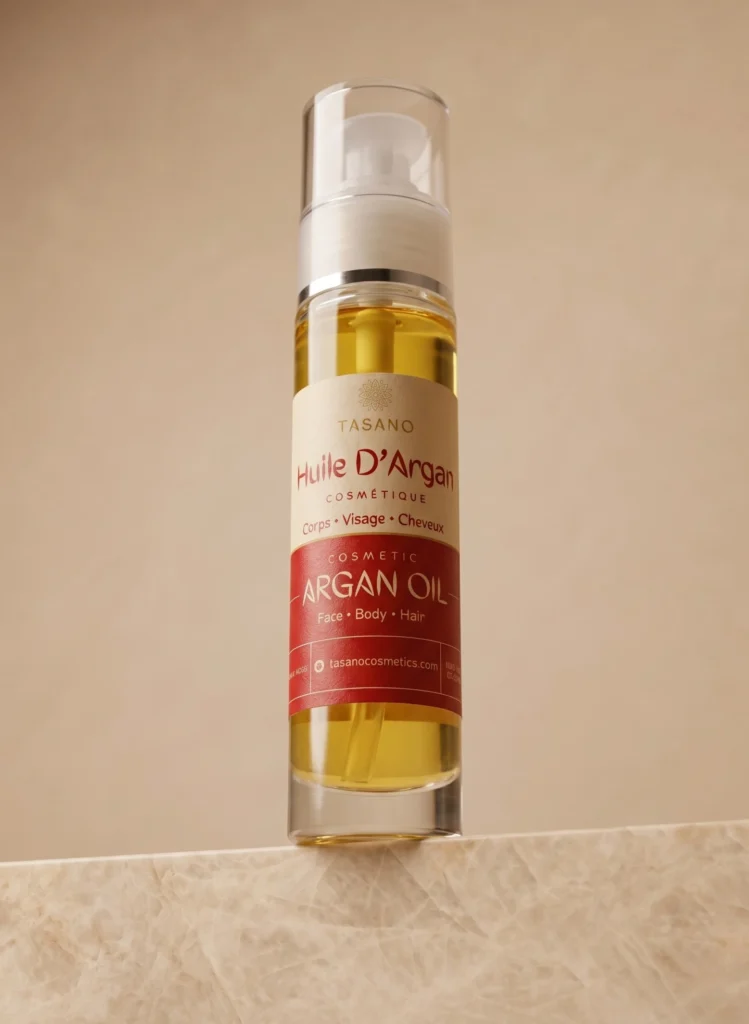
100% Pure Moroccan Argan Oil
Price range: $17.00 through $26.00 -
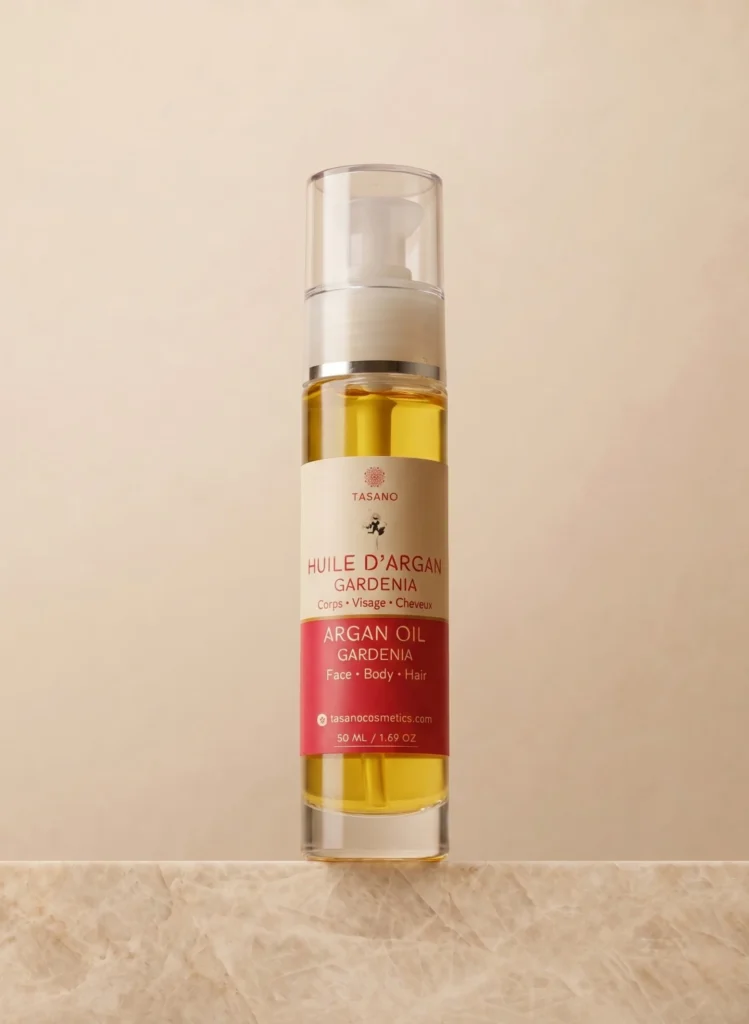
Gardenia Argan Oil for Hair & Body
$21.00 -
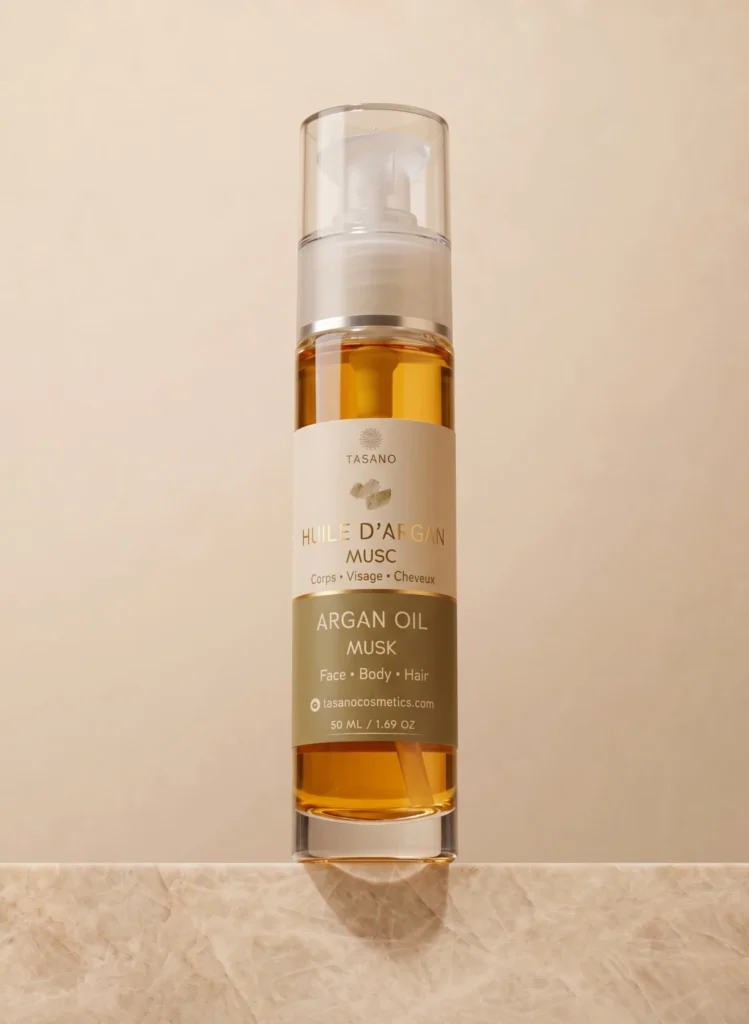
Musk Argan Oil for Hair & Body
$21.00 -
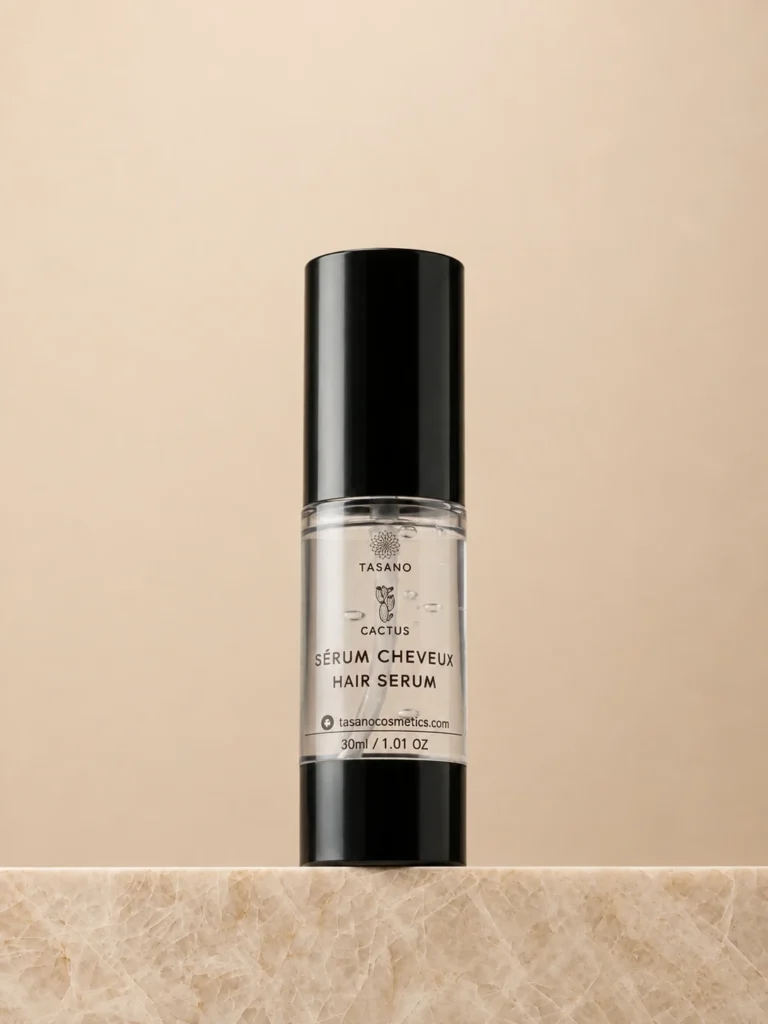
Moroccan Prickly Pear Hair Serum – Frizz Control
$9.00
FAQ
Is argan oil good for curly hair?
Yes. Argan oil can help curly hair feel softer, look shinier, reduce frizz, and improve manageability when used in small amounts on the lengths and ends.
How do you use argan oil for curly hair?
Apply argan oil after leave-in conditioner or curl cream, focusing on the mid-lengths and ends. Use a small amount to avoid weighing curls down.
Can argan oil define curls?
Argan oil can help curls look more defined by reducing frizz and smoothing the hair surface, but it works best when layered after moisture and curl styling products.
Is argan oil good for frizzy curly hair?
Yes. Argan oil is especially useful for frizzy curly hair because it helps smooth rough texture and add shine without making curls stiff.
Should I put argan oil on wet or dry curly hair?
Both can work. Use it on damp curls after styling for softness and frizz control, or on dry curls as a finishing oil for shine and polish.
Can argan oil weigh down curly hair?
Yes, if you use too much or apply it near the roots. Argan oil for curly hair works best in small amounts on the mid-lengths and ends, especially after a leave-in conditioner or curl cream.
Is argan oil good for coily hair?
Yes. Coily hair often benefits from argan oil’s softness, shine, and frizz-control benefits, especially when it is layered over water-based moisture.
Final Thoughts
Argan oil for curly hair works when it respects the curl pattern.
Used lightly, it can soften dry ends, smooth frizz, add shine, improve manageability, and make curls look more defined. Used heavily, it can flatten the hair and create buildup. The difference is not the oil. It is the method.
Hydrate first. Style second. Oil last. Focus on the lengths and ends, use only what your curls need, and let argan oil refine the result instead of carrying the whole routine.
That is how curls stay soft, polished, and alive without losing their natural shape.
Recommended products
Enjoyed this guide? Keep TASANO easier to find when you search for Moroccan beauty advice.
