

How to Choose Pure Argan Oil for Hair and Avoid Fake Moroccan Oil Blends
ByTASANO
Most “Moroccan oil” products are not the pure argan oil people think they are. If you want pure argan oil for hair, you need to know how to read the label, spot fake blends, and avoid paying premium prices for diluted formulas.
This matters because argan oil has become one of the most copied ingredients in beauty. The name “Moroccan oil” is everywhere, but many products using that language are blends built around silicones, fragrance, and cheaper oils with only a small amount of argan oil inside. That does not automatically make every blend bad, but it does mean you should know exactly what you are buying.
The goal is simple: if you are paying for authentic Moroccan argan oil, the bottle should give you purity, transparency, and real confidence, not vague marketing.
For the full Moroccan hair care system, read Moroccan Hair Care: The Complete Guide to Stronger, Healthier, Shinier Hair.
Table of Contents
What Is Pure Argan Oil for Hair?
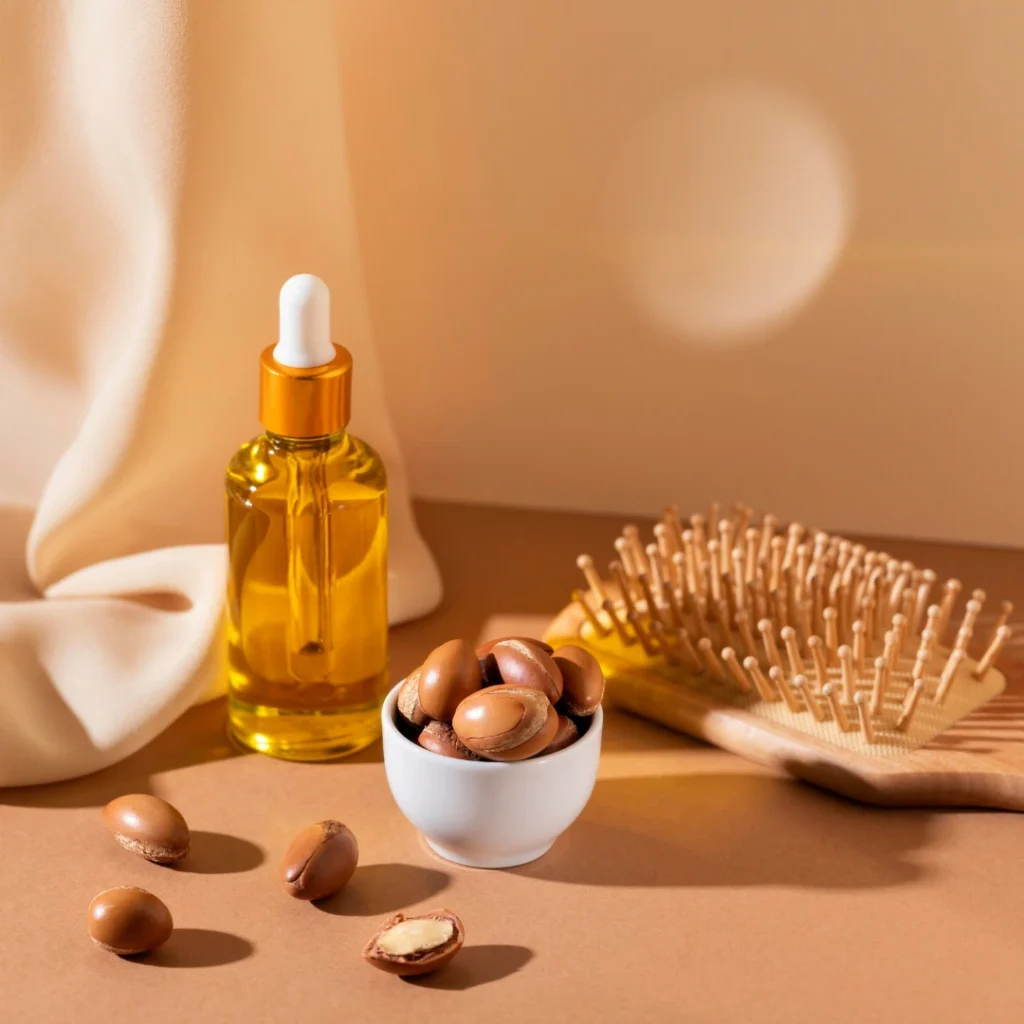
Pure argan oil for hair is oil pressed from the kernels of the Moroccan argan tree, Argania spinosa. In cosmetic use, it is valued for its lightweight nourishing feel, softening effect, shine, and ability to make dry or frizzy hair feel smoother and easier to manage.
The important word is pure.
A pure argan oil should not need a long ingredient list. If it is sold as 100% pure argan oil, the ingredient list should be clear and simple: Argania Spinosa Kernel Oil. That is the INCI name used for argan oil in cosmetic labeling.
When you are choosing pure argan oil for hair, you are not just choosing a beauty oil. You are choosing ingredient clarity.
For a full explanation of how argan oil benefits hair, read Argan Oil for Hair: Benefits, How to Use It and Results to Expect.
Argan oil is also a core step in traditional rituals, see how it’s used in practice in our guide to Moroccan hammam rituals and body care routines.
Moroccan Oil vs Argan Oil: What Is the Difference?
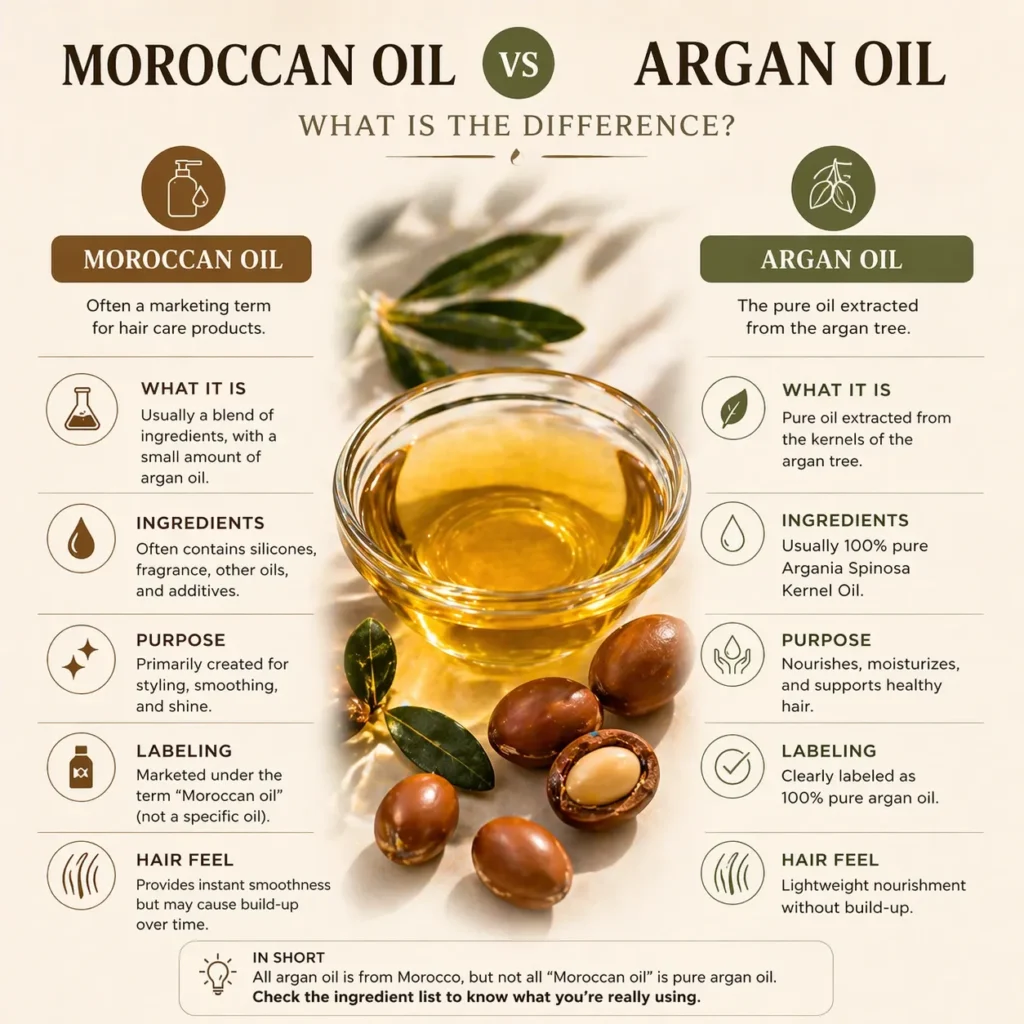
This is where many buyers get confused.
Argan oil is the actual oil from the argan kernel. Moroccan oil is often used as a marketing phrase. Sometimes it means real argan oil. Sometimes it means a silicone-based hair serum with a small amount of argan oil added for branding.
That difference matters.
A Moroccan oil blend may feel silky because of silicones, not because it contains much argan oil. Again, that does not automatically make it useless. Some styling products are designed to create slip and shine with multiple ingredients. But if your goal is pure argan oil for hair, then a “Moroccan oil” blend is not the same thing.
Use this simple rule:
- Pure argan oil = ingredient-led oil, usually one ingredient
- Moroccan oil blend = styling or cosmetic formula that may contain argan oil plus other ingredients
If you want authenticity, read the ingredient list. The front label is not enough.
For the wider beauty product authentication guide, read How to Choose Authentic Moroccan Beauty Products (Avoid Fake Argan, Nila & Oils).
Why Fake or Diluted Argan Oil Is So Common
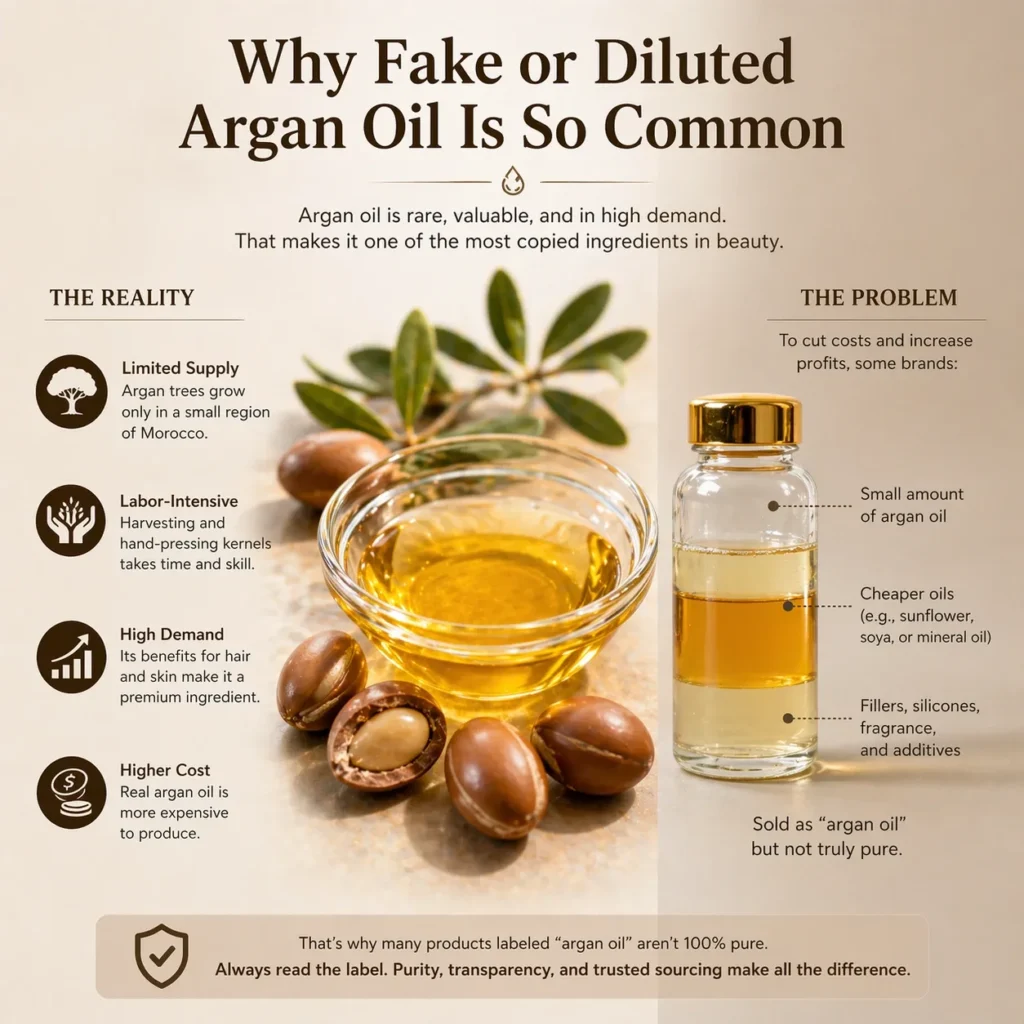
Argan oil is valuable because it is limited, labor-intensive, and strongly associated with Morocco. That makes it attractive for brands, but also easy to exploit in marketing.
Quality-control research on argan oil notes that authentication matters because chemical fingerprints can help verify oil quality and detect adulteration. Independent research has also shown that products labeled as 100% argan oil can sometimes be mixed with cheaper oils, which is exactly why buyers should not rely on the front label alone.
The problem is not only fraud. It is also dilution through vague beauty formulas. Many products borrow the prestige of argan oil while making it a minor ingredient. That is why choosing pure argan oil for hair requires more than trusting the words “Moroccan,” “gold,” or “repair” on the bottle.
7 Warning Signs of Fake Moroccan Oil Blends
1. The Ingredient List Is Too Long for a “Pure” Oil
If a bottle claims to be pure argan oil but the ingredient list includes silicones, mineral oil, perfume, colorants, or several other plant oils, it is not pure argan oil.
A true pure argan oil should be simple. For cosmetic argan oil, look for Argania Spinosa Kernel Oil. If that is not the only ingredient in a product marketed as pure, the label is already telling you the truth.
This is the fastest test and the one most people skip.
2. Argan Oil Appears Low on the Ingredient List
Ingredient lists usually appear in descending order by amount. If argan oil is buried after silicones, fragrance, or cheaper oils, you are probably buying a styling serum with a tiny argan-oil story attached to it.
That may still give shine. It may still reduce frizz. But it is not the same as buying pure argan oil for hair.
If you want the real oil, argan should not be hidden like a decoration.
3. The Product Uses “Moroccan Oil” More Than “Argan Oil”
“Moroccan oil” can sound premium, but it is also vague. A brand using that phrase without clear ingredient transparency may be leaning on Morocco’s beauty reputation without giving you much real argan oil.
Authentic products do not need to hide behind poetic naming. They tell you exactly what is inside.
If the packaging says “Moroccan oil” loudly but the ingredient list tells a different story, trust the ingredient list.
4. The Texture Feels Sticky, Heavy or Artificially Slippery
Pure argan oil should feel nourishing and smooth, not gluey, waxy, or oddly synthetic. If the product feels extremely slippery in a silicone-like way, it may be a serum rather than a true oil.
That does not mean it cannot be useful for styling. But if the goal is pure argan oil for hair, the texture should feel like a refined plant oil, not like a plastic-coated finish.
A good argan oil should leave hair softer and more polished, not suffocated.
5. The Scent Is Too Strong, Perfumed or Artificial
Pure cosmetic argan oil usually has a mild natural scent. It should not smell aggressively perfumed, sour, rancid, or overly roasted.
A strong fragrance can hide poor quality or make a product feel more luxurious than it really is. It can also make scalp use less ideal for people who prefer cleaner formulas.
There is nothing wrong with beautifully scented argan oils when they are clearly presented as scented products. The problem is when fragrance is used to disguise weak oil quality or vague formulation.
6. The Bottle Does Not Protect the Oil
Argan oil is sensitive to light, heat, and oxidation. Better packaging helps protect the oil’s quality for longer.
Look for darker glass, opaque packaging, or a bottle designed to reduce unnecessary light exposure. A clear plastic bottle sitting under bright light is not the best sign.
Storage also matters. Keep argan oil away from direct sunlight and heat to preserve its texture, scent, and performance.
7. The Price Looks Too Cheap to Be Real
Pure Moroccan argan oil is not supposed to be suspiciously cheap. If the price is unbelievably low, something is probably being compromised: purity, sourcing, freshness, packaging, or concentration.
That does not mean the most expensive bottle is automatically the best. But real argan oil has a cost because real argan oil has a supply chain.
Cheap “Moroccan oil” is often cheap for a reason.
How to Read an Argan Oil Label Properly
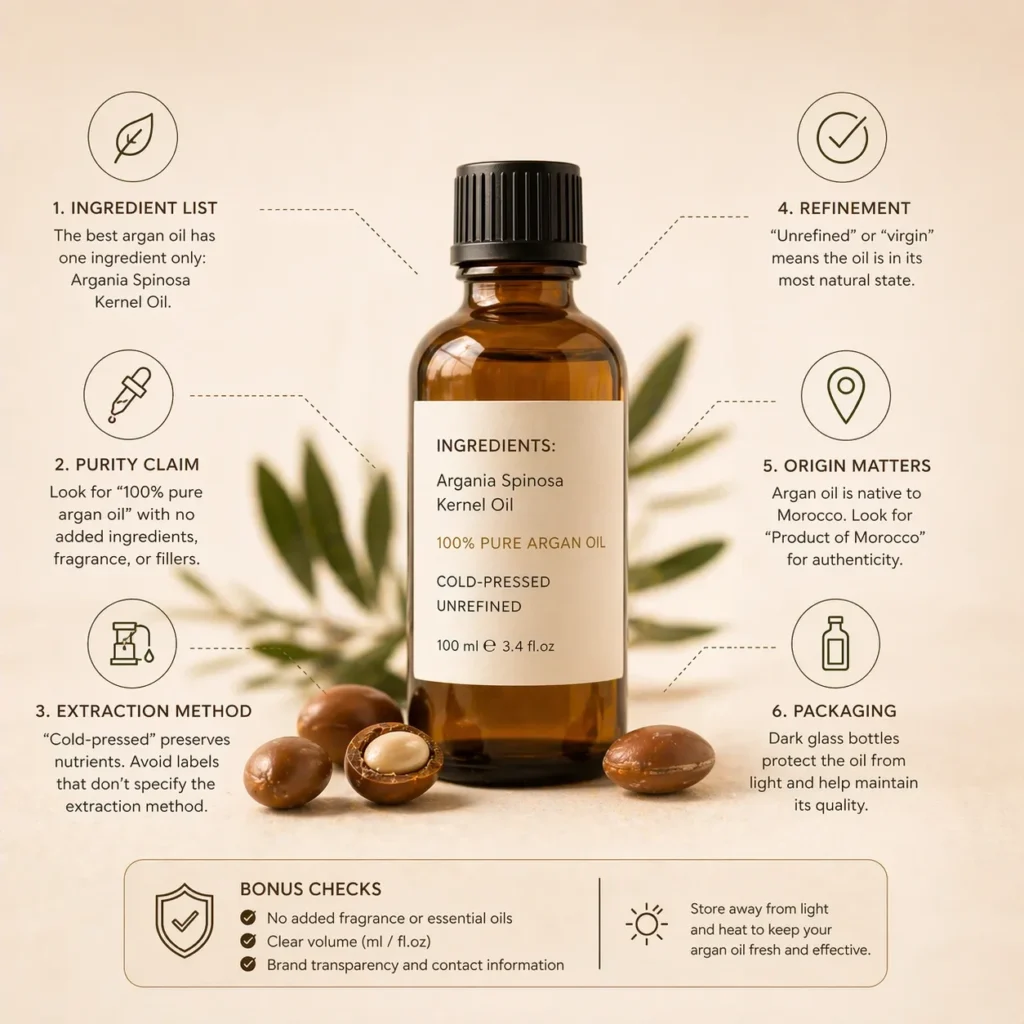
The label is where the truth is.
When choosing pure argan oil for hair, look for:
- Argania Spinosa Kernel Oil as the ingredient
- “100% pure” only when the ingredient list supports it
- clear origin or Moroccan sourcing information
- cosmetic-grade or hair-and-skin use if you are buying it for beauty
- packaging that protects the oil from light
- no vague ingredient hiding
Do not be distracted by words like “repair,” “gold,” “miracle,” or “Moroccan.” Those words can sell the product, but they do not prove purity.
If the label is vague, the product is vague.
What Pure Argan Oil Should Look, Feel and Smell Like
Pure argan oil for hair should usually have a clean golden tone, a smooth oil texture, and a mild natural scent. It should not look cloudy, smell rancid, feel sticky, or leave an unpleasant coating on the hair.
- Color
Cosmetic argan oil is often golden yellow. If it looks extremely pale, unusually dark, cloudy, or inconsistent, that is worth questioning.
- Texture
The texture should feel rich but not suffocating. It should spread easily and leave the hair softer, not strangely coated.
- Scent
The scent should be mild. A rancid smell suggests oxidation. An overpowering perfume suggests the formula may be more fragrance-led than oil-led.
- Performance
Pure argan oil should improve softness, shine, and manageability when used correctly. If your hair feels heavy, sticky, or dirty after a tiny amount, either the formula is wrong for you or the application is too heavy.
Cold-Pressed Argan Oil for Hair: Does It Matter?
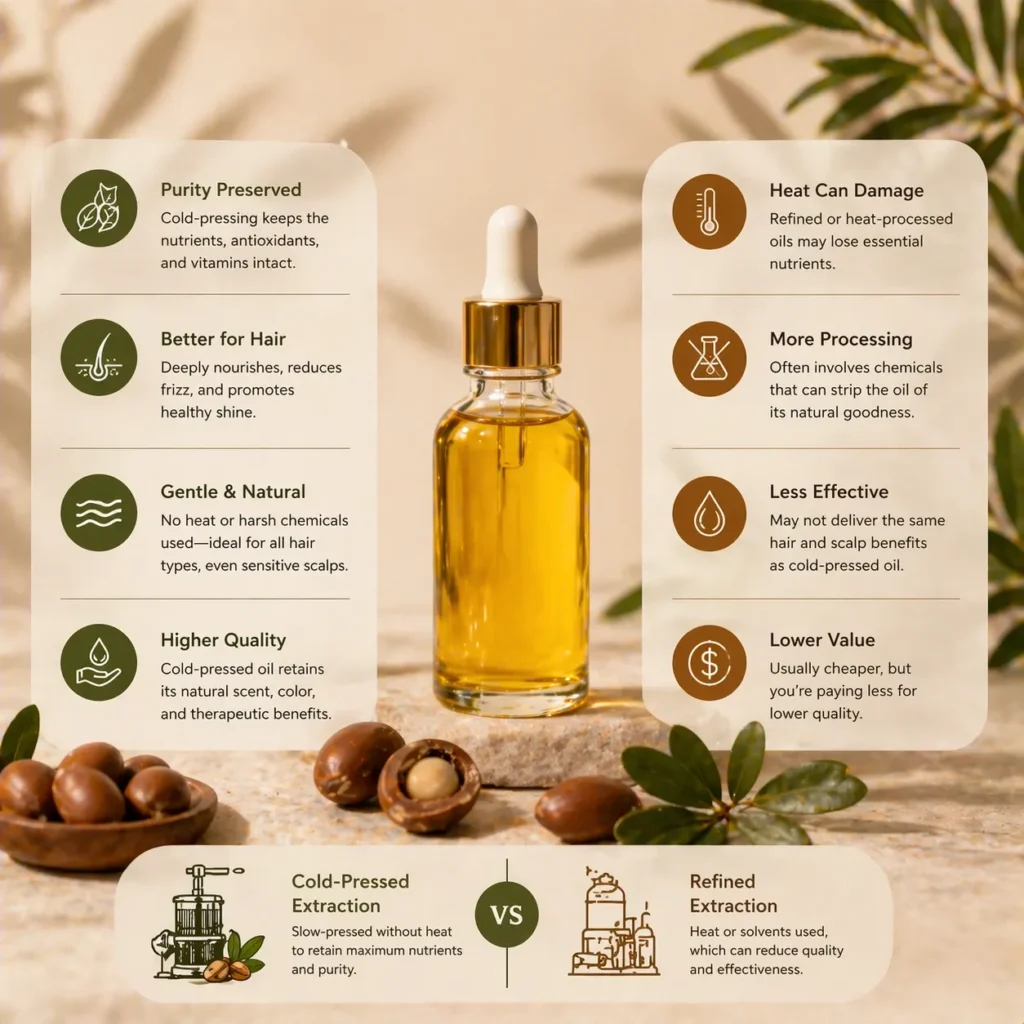
Cold-pressed argan oil is often preferred because the extraction process helps preserve oil quality without relying on excessive heat. Reviews on argan oil describe its cosmetic value as connected to its composition, including fatty acids, tocopherols, and other bioactive compounds.
For hair, this matters because you want an oil that feels fresh, stable, and effective. Cold-pressed does not automatically mean perfect, but it is a positive quality signal when combined with ingredient clarity, proper packaging, and transparent sourcing.
Do not buy based on one claim alone. Buy based on the full picture.
Cosmetic Argan Oil vs Culinary Argan Oil
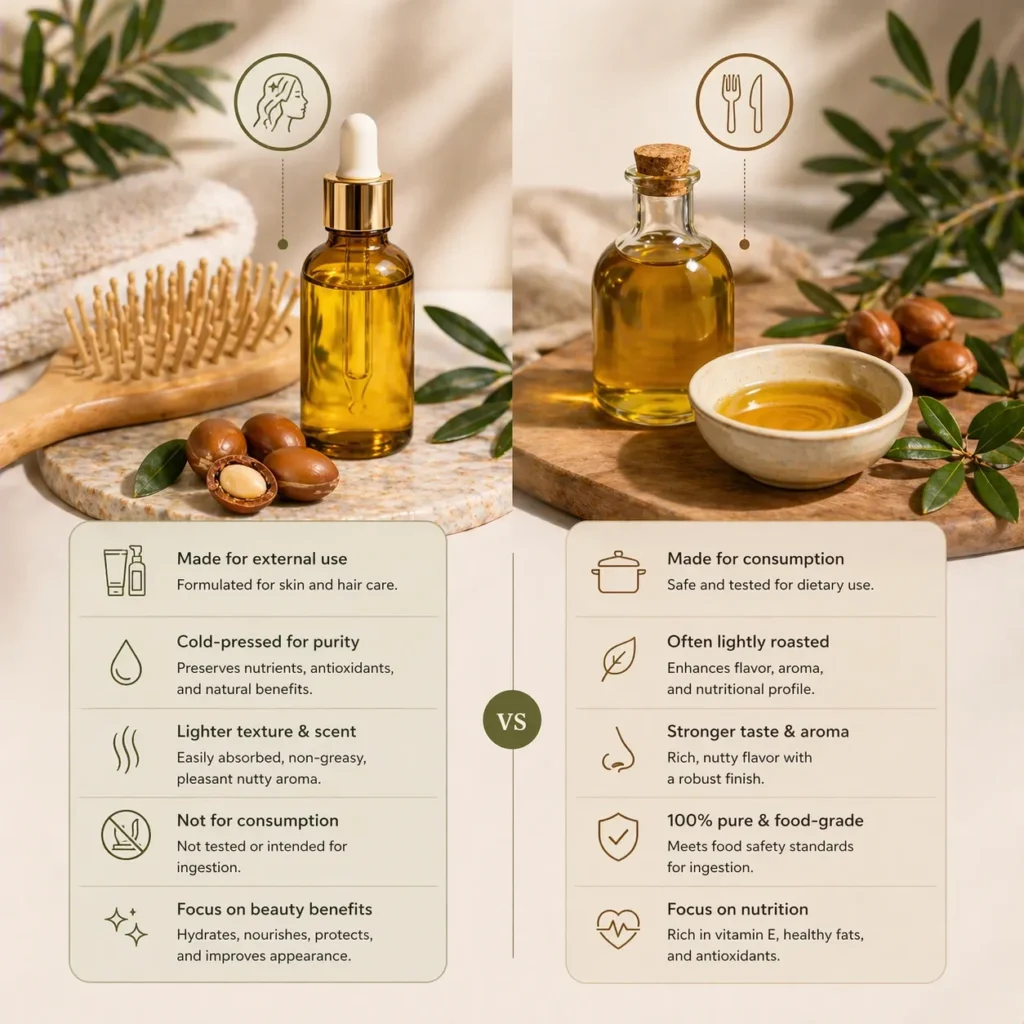
Cosmetic argan oil and culinary argan oil are not the same buying choice.
Culinary argan oil is often made from roasted kernels and has a stronger nutty aroma. Cosmetic argan oil is usually made from unroasted kernels and is intended for skin and hair use.
For hair, choose cosmetic-grade pure argan oil. It is the version built for beauty routines, not for eating.
If a product smells strongly roasted, check whether it is actually meant for culinary use.
Best Argan Oil for Different Hair Goals
- For dry hair
Choose pure argan oil for hair that needs softness, comfort, and smoother texture.
Read Argan Oil for Dry Hair: How to Use It for Frizz, Shine and Softness if dryness is your main concern.
- For frizz
Choose a clean argan oil or argan-rich formula that improves smoothness without leaving the hair greasy.
- For scalp use
Choose pure, simple formulas and use very small amounts only when dryness is the issue.
Read Argan Oil for Scalp: Dry Scalp, Dandruff and Scalp Care Benefits before applying oil to a flaky scalp.
- For growth goals
Choose argan oil for length retention, not direct growth. It helps protect the lengths and ends so hair is less likely to break.
Read Does Argan Oil Help Hair Growth? Benefits, Limits and How to Use It for the honest breakdown.
- For curls
Choose lightweight pure argan oil and apply carefully to damp curls or dry ends.
Read How to Use Moroccan Argan Oil for Curly Hair for a curl-specific routine.
How to Use Pure Argan Oil for Hair
Pure argan oil works best in small amounts. More oil does not mean better hair. It usually means greasy hair.
- On damp hair
Apply 1 to 4 drops to the mid-lengths and ends after washing. This helps softness, shine, and frizz control.
- On dry hair
Use 1 to 2 drops as a finishing touch on the ends or frizzy areas.
- As a pre-wash treatment
Apply a richer amount to dry lengths and ends 30 minutes before washing.
- On the scalp
Use only when the scalp is dry, not when dandruff, oiliness, or buildup are the real issue.
Argan oil also belongs to Morocco’s wider beauty tradition, explained in Moroccan Beauty Products: The Complete Guide to Glowing, Clear, and Youthful Skin.
Pure Argan Oil for Hair Backed by Quality and Cosmetic Science
Pure argan oil for hair deserves attention because quality affects performance. Reviews on PubMed Central describe argan oil’s cosmetic value as connected to its unique composition, including fatty acids, tocopherols, and antioxidant compounds. Research on quality control and authentication of argan oils also shows why purity matters: chemical fingerprinting can help verify authenticity and detect adulteration.
The Quadram Institute has reported that some commercial products labeled as 100% argan oil were not actually pure, which reinforces why ingredient transparency and trusted sourcing matter. Google’s own search guidance also emphasizes helpful, people-first content and meta descriptions that accurately inform and interest users, which is why this guide focuses on practical buying decisions rather than vague beauty claims.
Choosing Authentic Argan Oil With Peace of Mind
If you want pure argan oil for hair, do not leave it to guesswork. Choose a source that makes purity, origin, and ingredient clarity easy to verify.
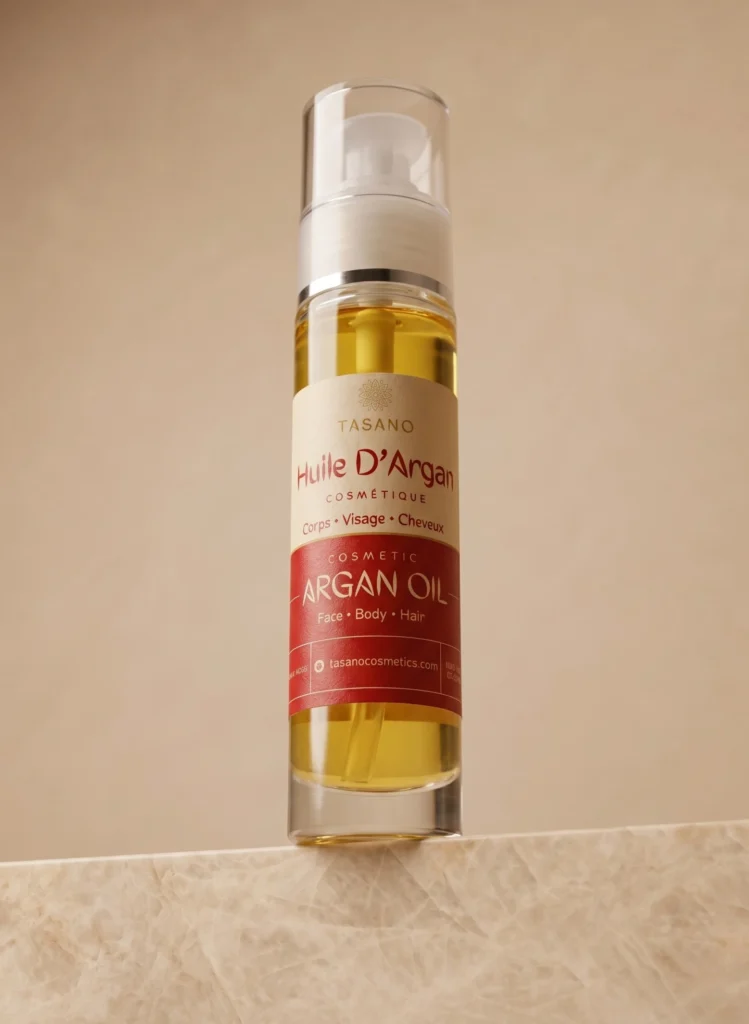
TASANO’s 100% Pure Moroccan Argan Oil is made for readers who want authentic Moroccan argan oil without the confusion of vague “Moroccan oil” blends. It fits naturally into routines for dry hair, frizz, shine, softness, scalp comfort, and length retention.
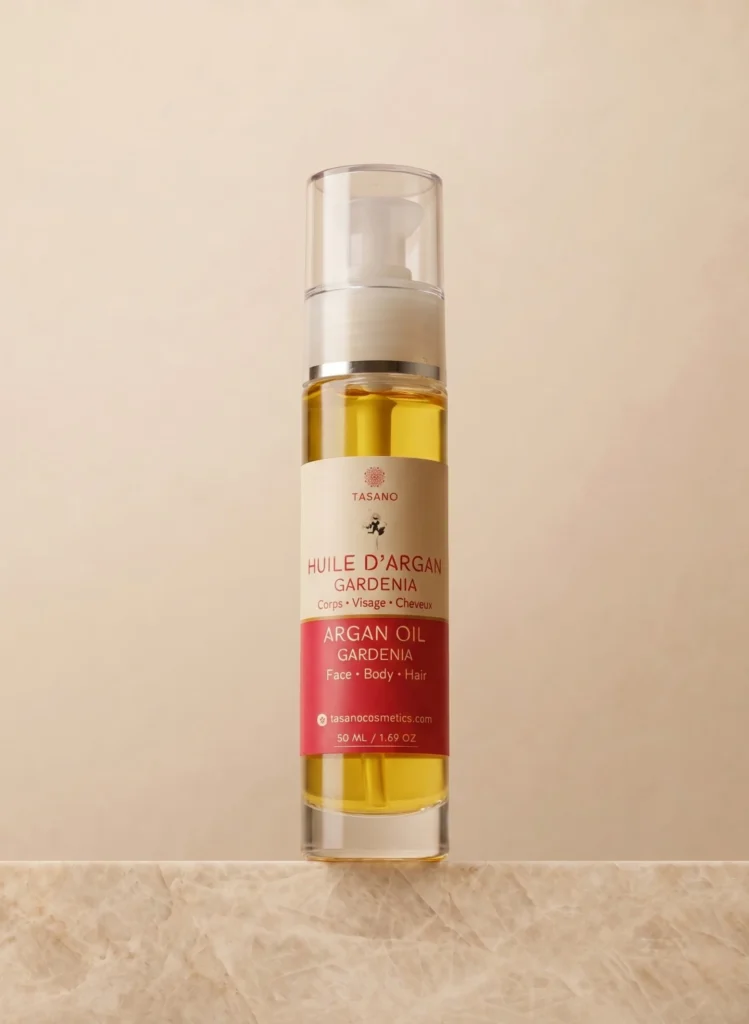
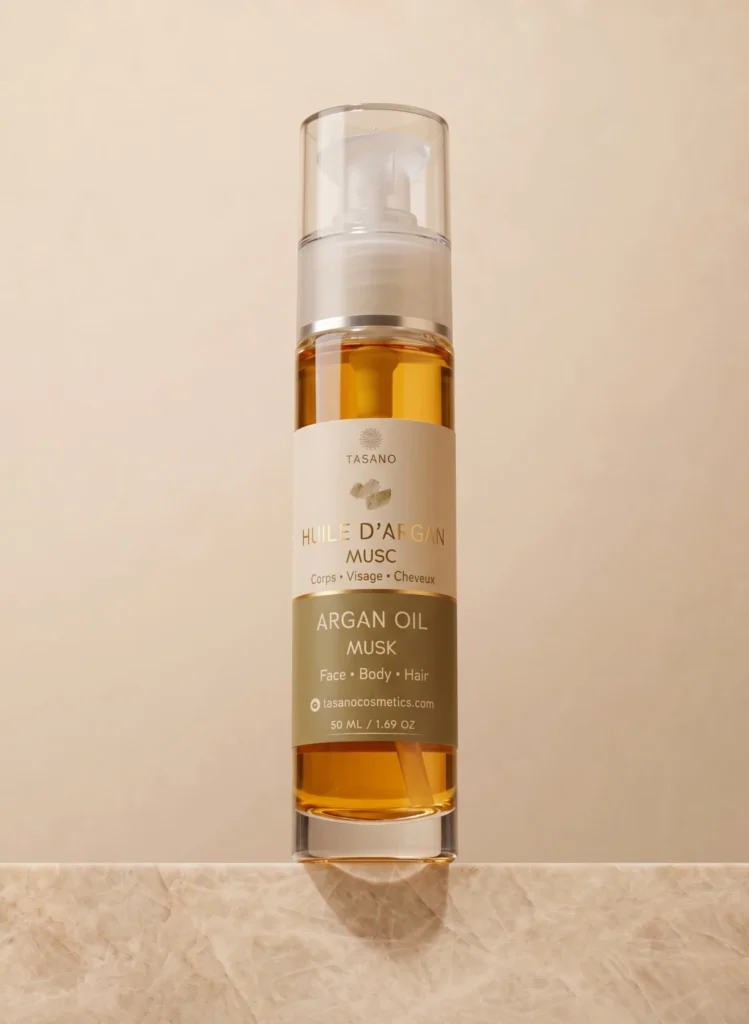
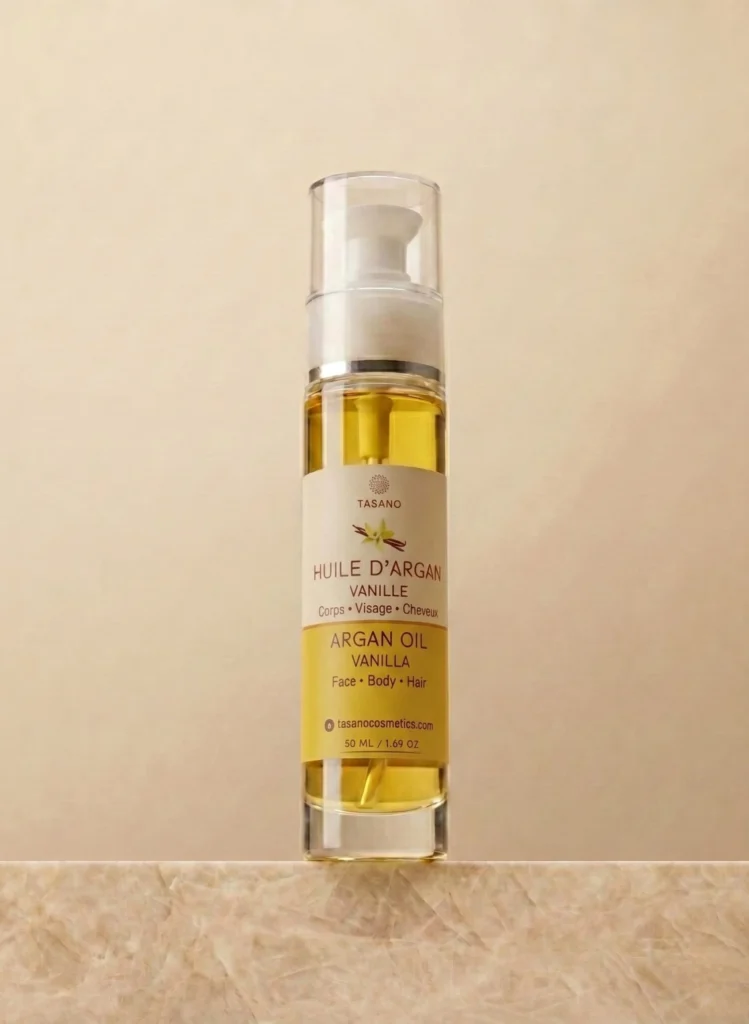
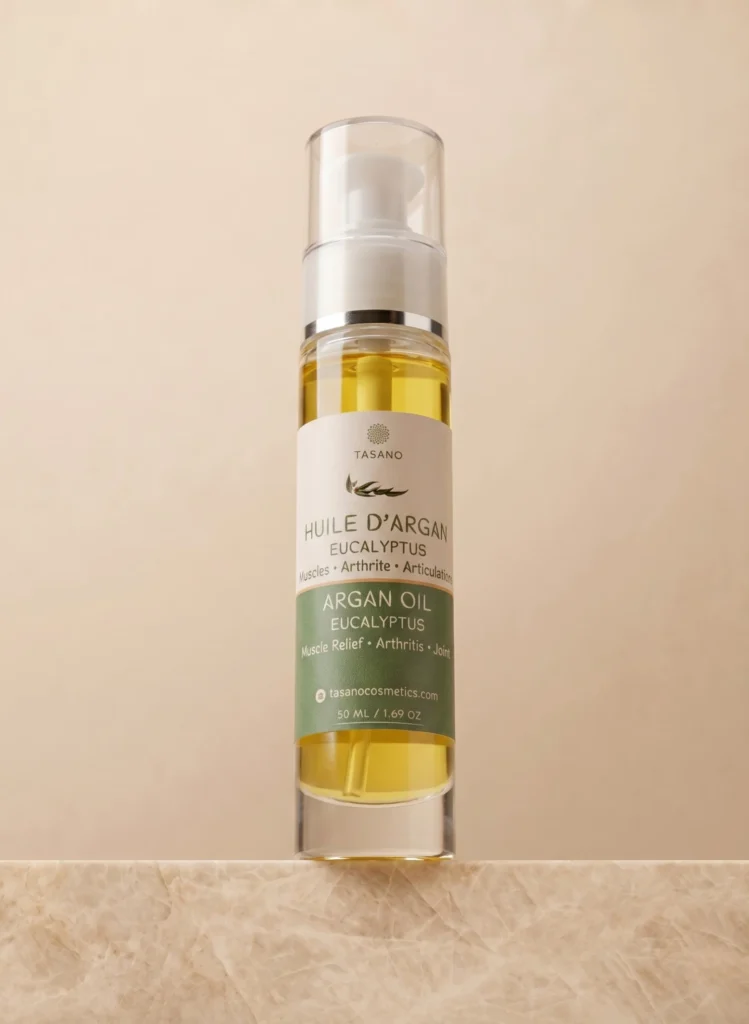
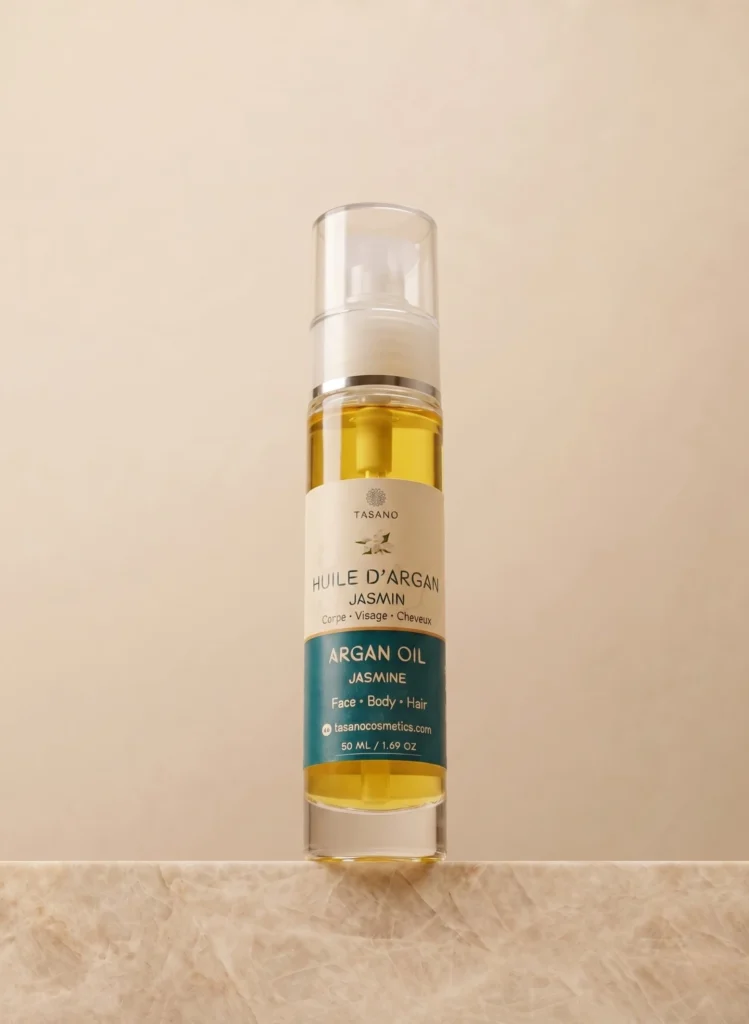
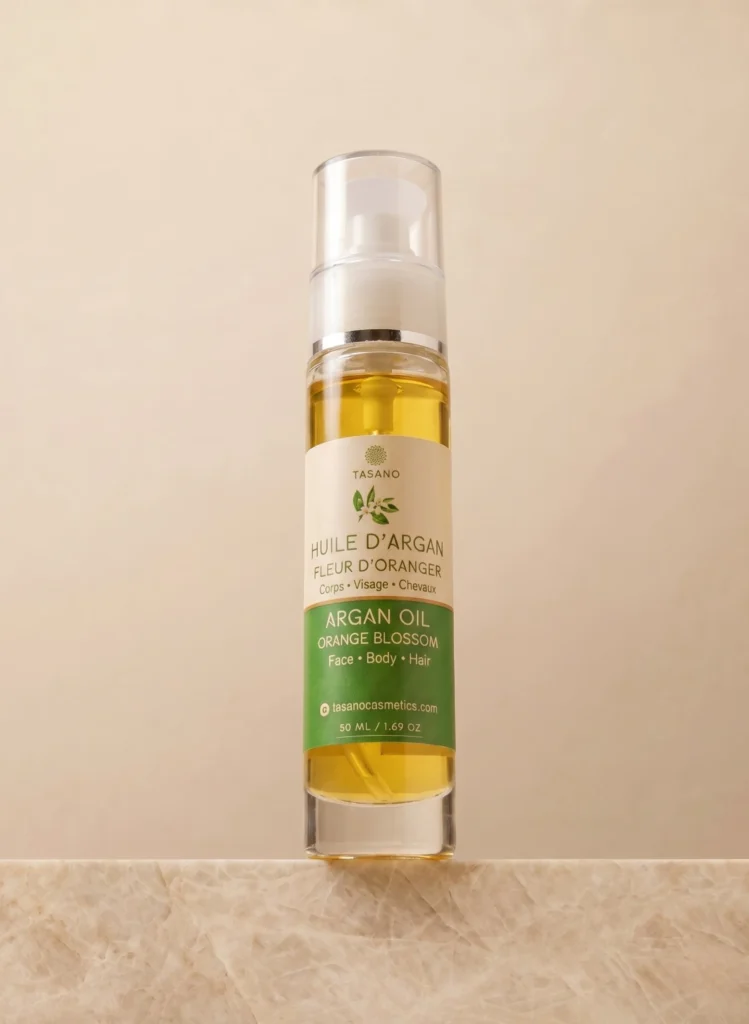
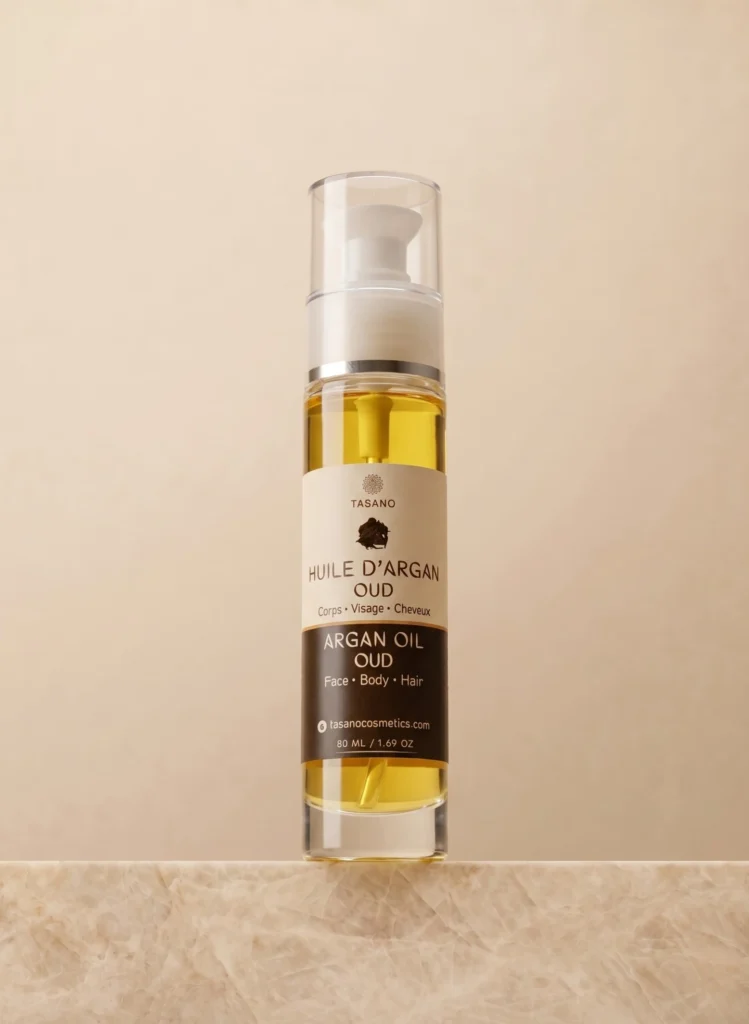
For those who want the same argan-oil ritual with a more elegant sensory finish, TASANO’s scented argan oils add refined notes such as musk, vanilla, and gardenia while keeping the routine rooted in Moroccan beauty tradition.
Authenticity should feel calm, not confusing. When the oil is clear, the routine becomes easier to trust.
Recommended products
-
100% Pure Moroccan Argan Oil
Price range: $ 17.00 through $ 26.00 -
Gardenia Argan Oil for Hair & Body
$ 21.00 -
Musk Argan Oil for Hair & Body
$ 21.00 -
Vanilla Argan Oil for Hair & Body
$ 20.00
FAQ
How can you tell if argan oil is pure?
Check the ingredient list first. Pure argan oil should list Argania Spinosa Kernel Oil clearly. If a “pure” oil contains silicones, fragrance, mineral oil, or multiple other oils, it is not pure.
What is the best pure argan oil for hair?
The best pure argan oil for hair is cosmetic-grade, clearly labeled, properly packaged, and transparent about Moroccan origin. It should feel smooth, smell fresh, and list argan oil clearly.
Is Moroccan oil the same as argan oil?
Not always. Argan oil is the actual oil from the argan kernel. “Moroccan oil” is often a marketing phrase and may refer to a blend that contains only some argan oil.
What should pure argan oil smell like?
Pure cosmetic argan oil usually has a mild natural scent. It should not smell rancid, sour, heavily perfumed, or strongly roasted.
Is cold-pressed argan oil better for hair?
Cold-pressed argan oil is generally a good quality signal because it helps preserve the oil’s natural composition, but it should still be judged alongside ingredient clarity, packaging, and sourcing.
Can fake argan oil damage hair?
A fake or poor-quality blend may not give the benefits you expect and may leave hair coated, greasy, or irritated. The bigger issue is that you may be paying for argan oil while getting mostly filler ingredients.
Should argan oil be in a dark bottle?
Dark or protective packaging is better because argan oil can be affected by light and oxidation. Packaging is not the only quality signal, but it matters.
Final Thoughts
Pure argan oil is simple. The market around it is not.
Most products labeled “Moroccan oil” rely on branding, texture, and fragrance to feel premium. That does not mean they are giving you real argan oil. If you want the actual benefits, softness, smoother texture, better-looking lengths, you have to look past the front label and judge the formula.
The shortcut is clear:
If it’s sold as pure, it should look pure on the ingredient list.
Anything else is a blend, sometimes useful, but not the same product.
Once you understand that difference, choosing becomes easier. You stop guessing. You stop overpaying for diluted formulas. You start building a routine based on ingredients that actually do what you expect.
And that’s the real advantage: not more products, better decisions.
Recommended products
Enjoyed this guide? Keep TASANO easier to find when you search for Moroccan beauty advice.
