

Does Argan Oil Help Hair Growth? Benefits, Limits and How to Use It
ByTASANO
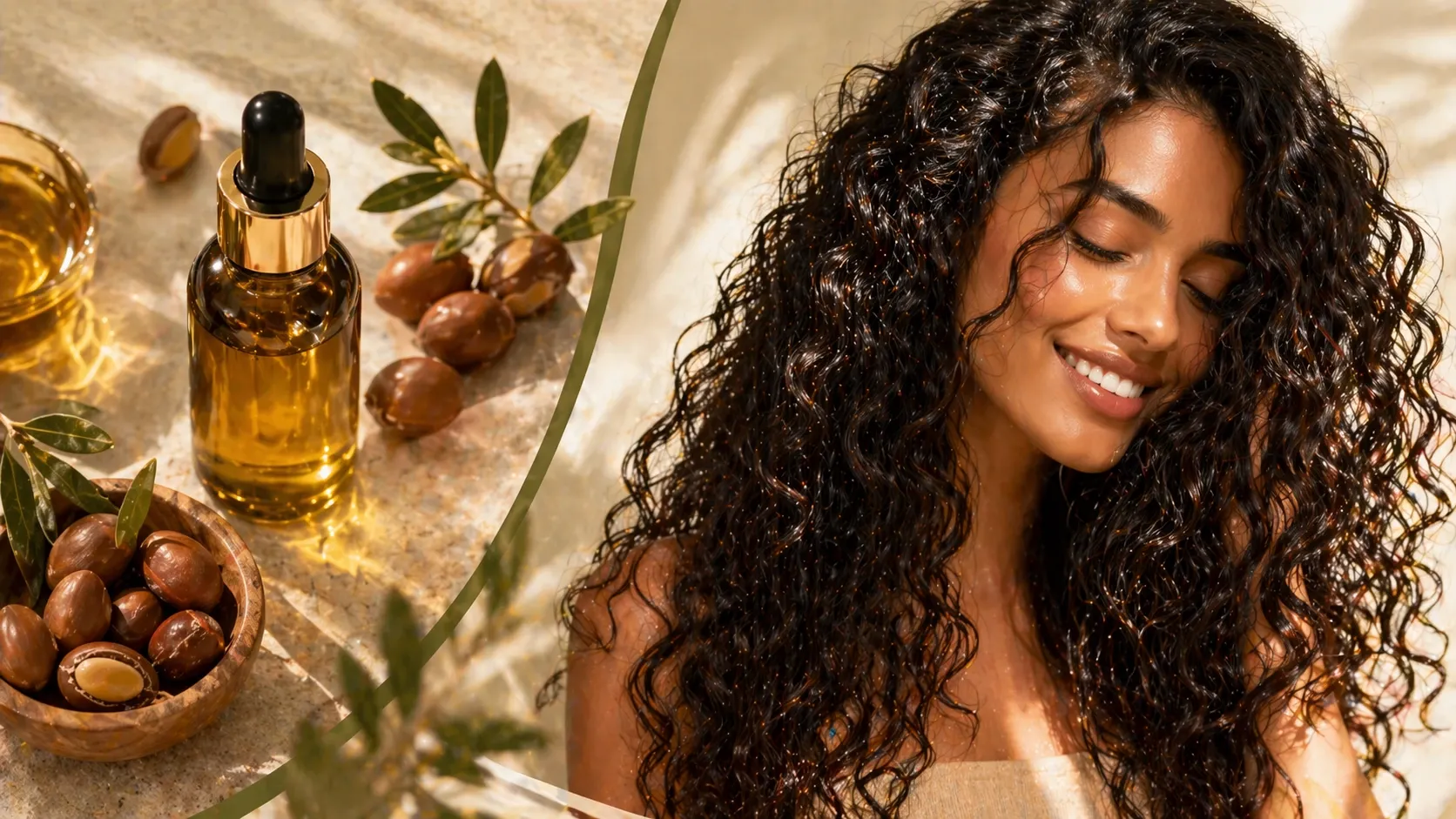
Argan oil can help your hair look healthier and retain more length, but it does not directly force faster hair growth. The real value of argan oil for hair growth is in reducing dryness, breakage, frizz and roughness so the hair you already grow has a better chance of staying strong.
Argan oil for hair growth is often misunderstood, especially when people expect it to act like a direct growth stimulant.
That distinction matters. Many people think their hair is “not growing,” when the real problem is that the ends keep breaking before the length becomes visible. In that case, argan oil can be useful.
While argan oil for hair growth does not directly stimulate follicles, it helps create better conditions for length retention. But if the goal is true follicle stimulation or treating medical hair loss, argan oil is not the strongest option. For that, rosemary oil has more direct hair-growth discussion behind it, while persistent or sudden hair loss should be evaluated by a dermatologist. The American Academy of Dermatology is clear that effective hair loss treatment starts with identifying the cause.
For the full hair care system, read Moroccan Hair Care: The Complete Guide to Stronger, Healthier, Shinier Hair.
Table of Contents
Does Argan Oil Help Hair Growth?
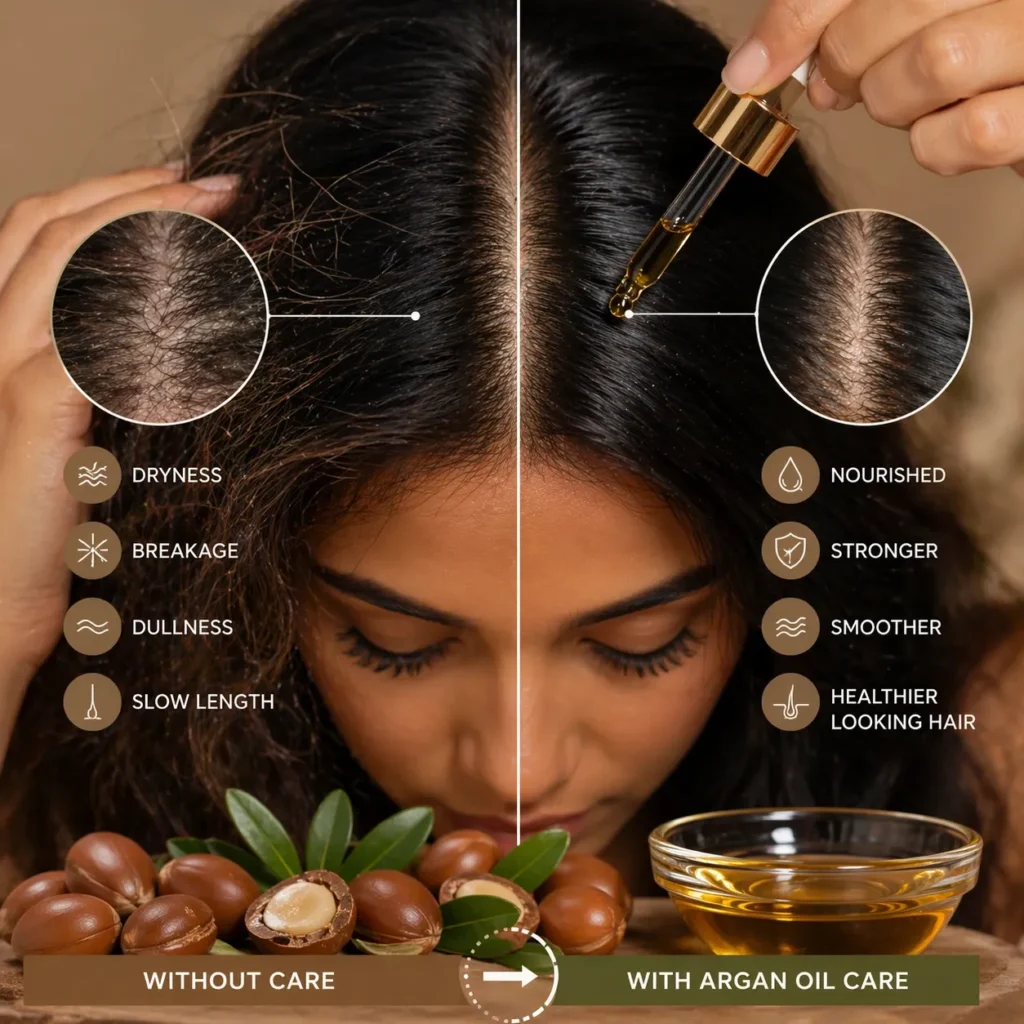
Argan oil does not directly stimulate hair follicles or guarantee faster hair growth. It is better understood as a hair health and length-retention oil.
The real strength of argan oil for hair growth lies in how it improves hair condition and reduces breakage.
That means argan oil can support the conditions that make longer-looking hair possible: softer strands, less dryness, smoother ends, easier detangling and reduced breakage from rough handling. Cleveland Clinic notes that argan oil can add a protective layer to the hair and help strengthen hair damaged by heat or chemicals, while broader hair-oiling guidance explains that oils can help moisturize the hair and improve softness when used correctly.
So the honest answer is: argan oil may help you keep more length, but it is not a proven hair-growth treatment.
The key to using argan oil for hair growth effectively is understanding that it supports retention, not rapid regrowth.
For a complete breakdown of the ingredient beyond growth claims, read Argan Oil for Hair: Benefits, How to Use It and Results to Expect.
Argan Oil for Hair Growth vs Length Retention
This is the part most people get wrong.
Hair growth happens at the scalp, inside the follicle. Length retention happens along the hair shaft, especially at the ends. If the scalp is producing new growth but the lengths keep snapping, the hair may seem like it is not growing even when it is.
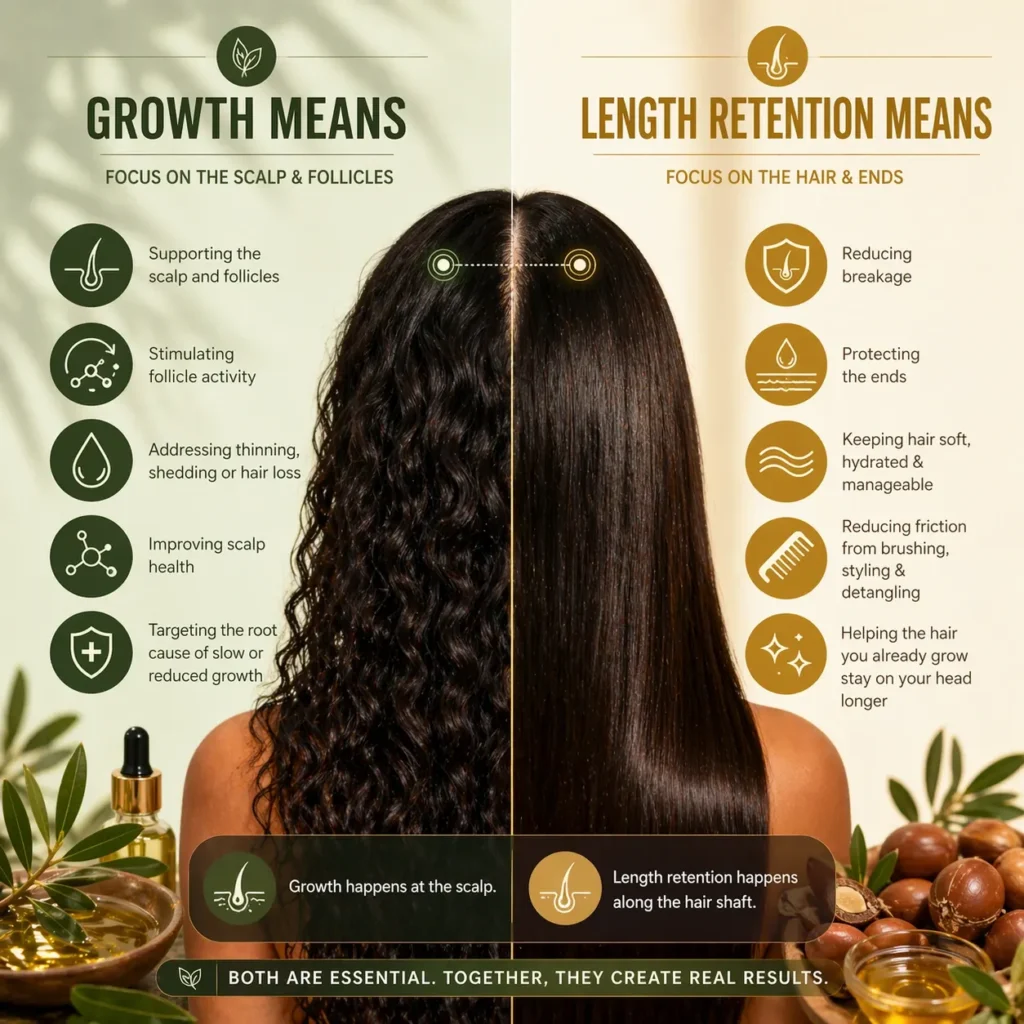
Argan oil works mostly on the visible hair fiber. It helps dry, rough, frizzy or fragile strands feel softer and more manageable. That can reduce the kind of breakage that makes progress look invisible.
Growth means:
- supporting the scalp and follicles
- addressing thinning, shedding or follicle activity
- targeting the root cause of slow or reduced growth
Length retention means:
- reducing breakage
- protecting the ends
- keeping dry hair soft and manageable
- helping the hair you already grow stay on your head longer
Argan oil is stronger for length retention than direct growth. When used correctly, argan oil for hair growth supports healthier-looking length over time.
When the goal is stronger, more resilient hair, argan oil for hair growth becomes a valuable supporting step.
7 Honest Benefits of Argan Oil for Hair Growth Goals
1. Helps Reduce Breakage That Makes Hair Look Like It Is Not Growing
A lot of people blame slow growth when the real issue is breakage. If the ends are dry, brittle or constantly snapping, the hair may grow from the scalp but never appear longer. The benefits of argan oil for hair growth are most visible when breakage is the main issue.
Argan oil helps by making the lengths feel softer, smoother and less fragile. That matters because dry hair is easier to damage through brushing, friction, styling and heat. When argan oil improves lubrication and manageability, the hair is less likely to be stressed every time it is handled.
This is why argan oil can be useful for growth goals even if it does not directly stimulate the follicle. It helps protect the progress already happening.
2. Helps Dry Hair Stay Softer and More Flexible
Many people turn to argan oil for hair growth when their hair feels dry, weak, or prone to snapping.
Dry hair breaks more easily because it loses flexibility. When the hair fiber feels rigid, rough or straw-like, simple daily actions such as detangling, styling or tying the hair back can create unnecessary stress.
Argan oil helps dry hair feel more supple. That softness is not just cosmetic. It can make the hair easier to work with, which reduces aggressive brushing and pulling.
For readers whose hair feels thirsty or rough, the better supporting article is Argan Oil for Dry Hair: How to Use It for Frizz, Shine and Softness.
3. Helps Smooth Frizz and Rough Texture
Frizz is often a sign that the hair surface is dry, uneven or lifted. That rough surface makes hair harder to control and easier to tangle. Argan oil helps smooth the feel of the hair, which can make the entire routine less damaging.
This matters for growth goals because frizz and tangling often lead to rough handling. The more the hair catches, knots and resists styling, the more likely it is to break.
If your hair struggles with dryness and frizz, argan oil for hair growth can help improve manageability and softness. It helps reduce that friction-heavy cycle by making hair behave more smoothly.
4. Helps Protect Ends Between Wash Days
The ends are the oldest part of the hair and usually the first place where breakage shows. They have experienced the most heat, brushing, weather, friction and styling.
A small amount of argan oil on the ends can help them feel less dry and look less worn out between wash days. Cleveland Clinic describes argan oil as adding a protective layer to the hair, which is one reason it is often used after heat or chemical stress.
If your ends always look rough while the roots look fine, your growth problem may be a retention problem. Argan oil fits that problem well.
5. Supports Easier Detangling and Less Mechanical Damage
Detangling is where a lot of breakage happens. Dry, rough hair catches on itself. Then the brush or comb forces through the knots, and the hair snaps.
Using argan oil for hair growth regularly can make the hair feel smoother and easier to detangle.
Argan oil helps improve slip, which makes the hair easier to separate and style without as much force. Hair cosmetics literature explains that conditioning and lubrication reduce friction and improve manageability, which is exactly the kind of practical benefit that matters for fragile lengths.
This is not a glamorous benefit, but it is one of the most important. Less pulling means less unnecessary breakage.
6. Helps Hair Look Healthier While You Work on Growth
Hair growth takes time. During that period, argan oil can help the hair look better immediately: shinier, smoother, softer and more polished.
That matters because many people abandon routines when the hair still looks rough while they wait for growth. Argan oil gives visible cosmetic improvement while the longer-term routine continues.
This is where argan oil earns its place. It may not be the growth engine, but it helps the hair look healthier during the journey.
7. Pairs Well With True Growth-Focused Oils
Argan oil works best for the lengths and ends. For scalp-focused growth support, rosemary oil is the stronger option. A widely cited clinical trial compared rosemary oil with 2% minoxidil over six months in androgenetic alopecia, and later reviews continue to discuss rosemary oil as one of the better-known natural options in hair-growth literature.
The smartest routine is not forcing argan oil to do everything. Use rosemary oil on the scalp for growth-focused care, and use argan oil on the lengths and ends for softness, shine and breakage reduction.
For the scalp side of the routine, read Rosemary Oil for Hair Growth: Does It Work and How to Use It.
What Argan Oil Cannot Do for Hair Growth
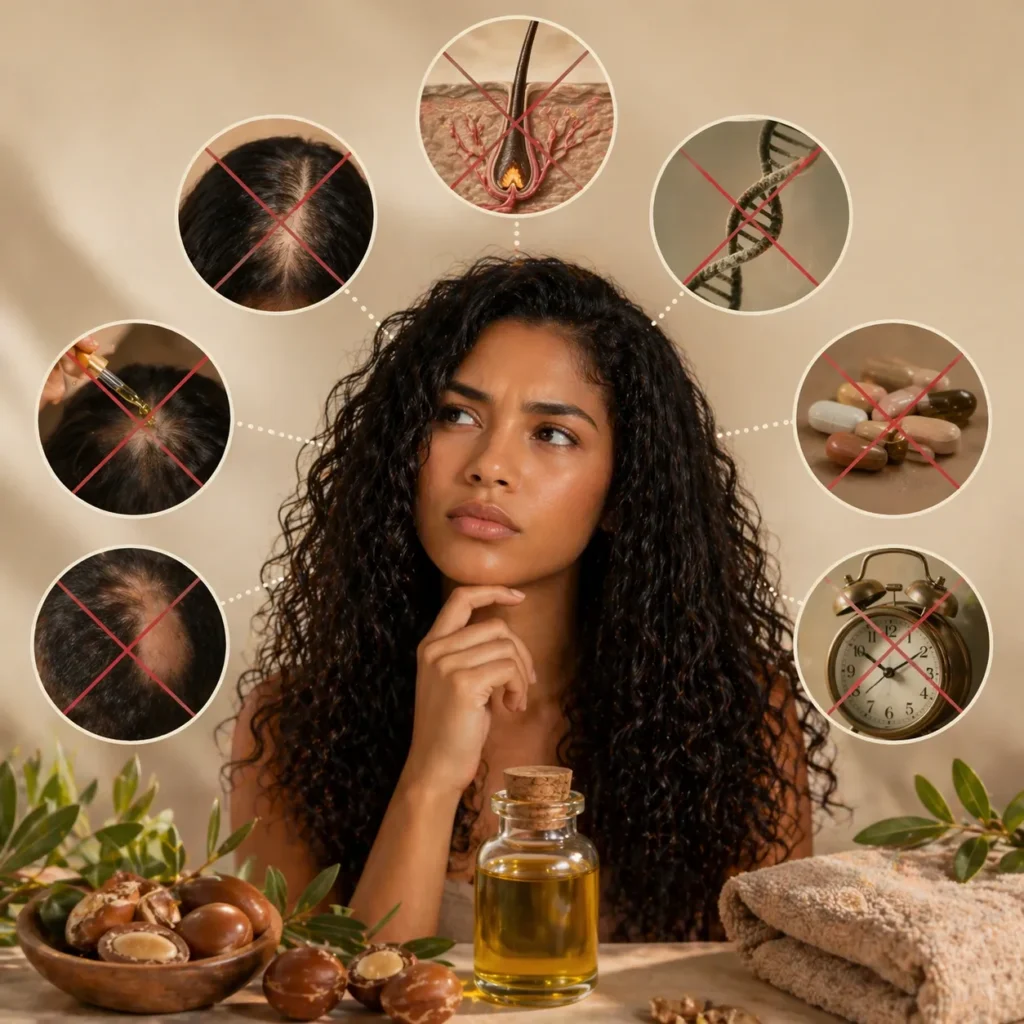
Argan oil is useful, but it has limits.
It cannot:
- guarantee faster hair growth
- reverse genetic hair loss
- replace medical treatment for alopecia
- fix hormonal shedding
- regrow hair from inactive follicles
- solve nutrient-related hair loss
- repair severe damage overnight
The American Academy of Dermatology explains that hair loss has many possible causes and that effective treatment starts with identifying the cause. That matters because using oil when the real issue is hormonal, genetic, nutritional or medical can waste valuable time.
If hair loss is sudden, severe, patchy or getting worse, do not treat it like a cosmetic issue.
When Argan Oil Makes Sense for Hair Growth Goals
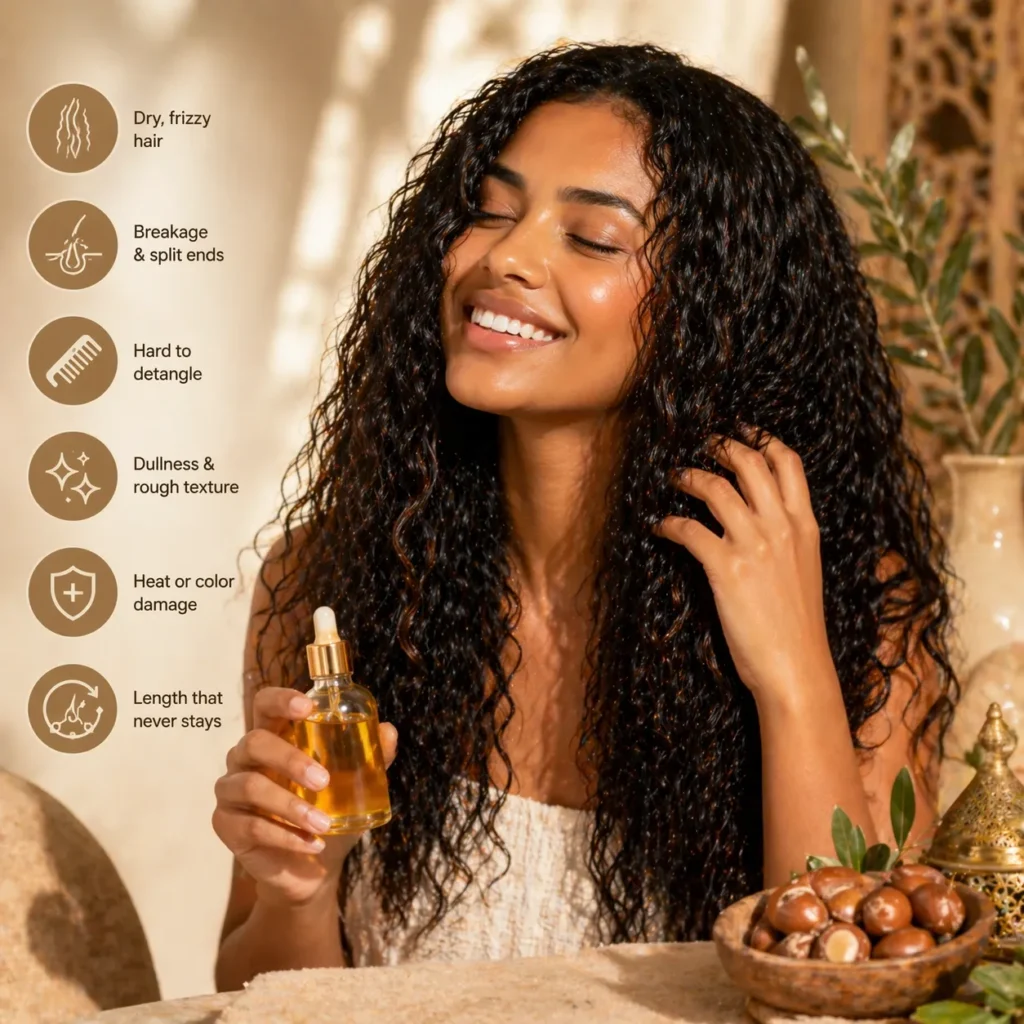
Argan oil makes sense when the issue is:
- dry ends
- breakage
- rough texture
- frizz
- dullness
- hard-to-detangle hair
- length that never seems to stay
- hair damaged by heat, coloring or frequent styling
In these cases, argan oil supports the hair you already have. It helps the lengths stay softer and easier to manage so the hair can appear longer and healthier over time.
When Rosemary Oil Is the Better Choice
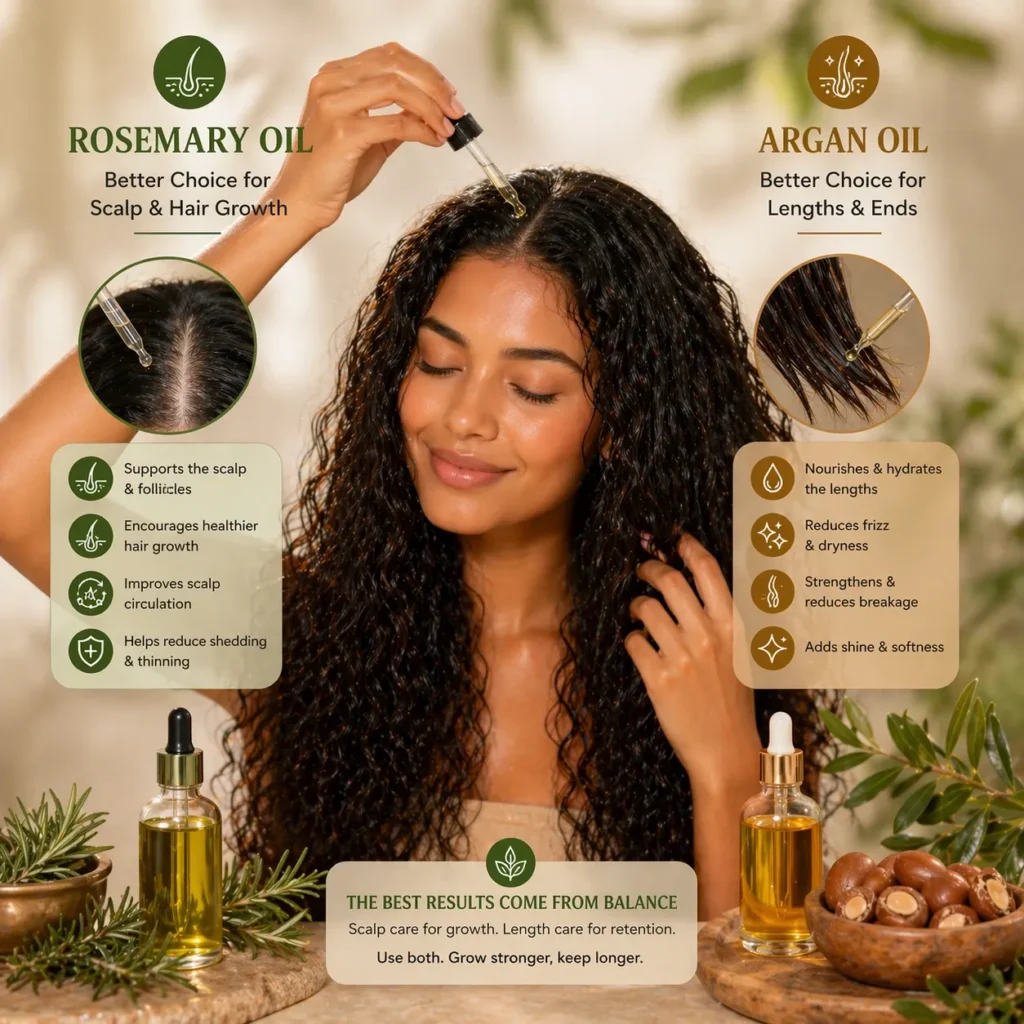
If your main concern is thinning, reduced density, a wider part, weaker roots or scalp-focused growth support, rosemary oil is usually the better oil to focus on.
Rosemary oil is applied to the scalp, where growth happens. Argan oil is mainly used on the lengths and ends, where breakage happens.
Use this simple rule:
- Rosemary oil for scalp-focused growth routines
- Argan oil for softness, shine and length retention
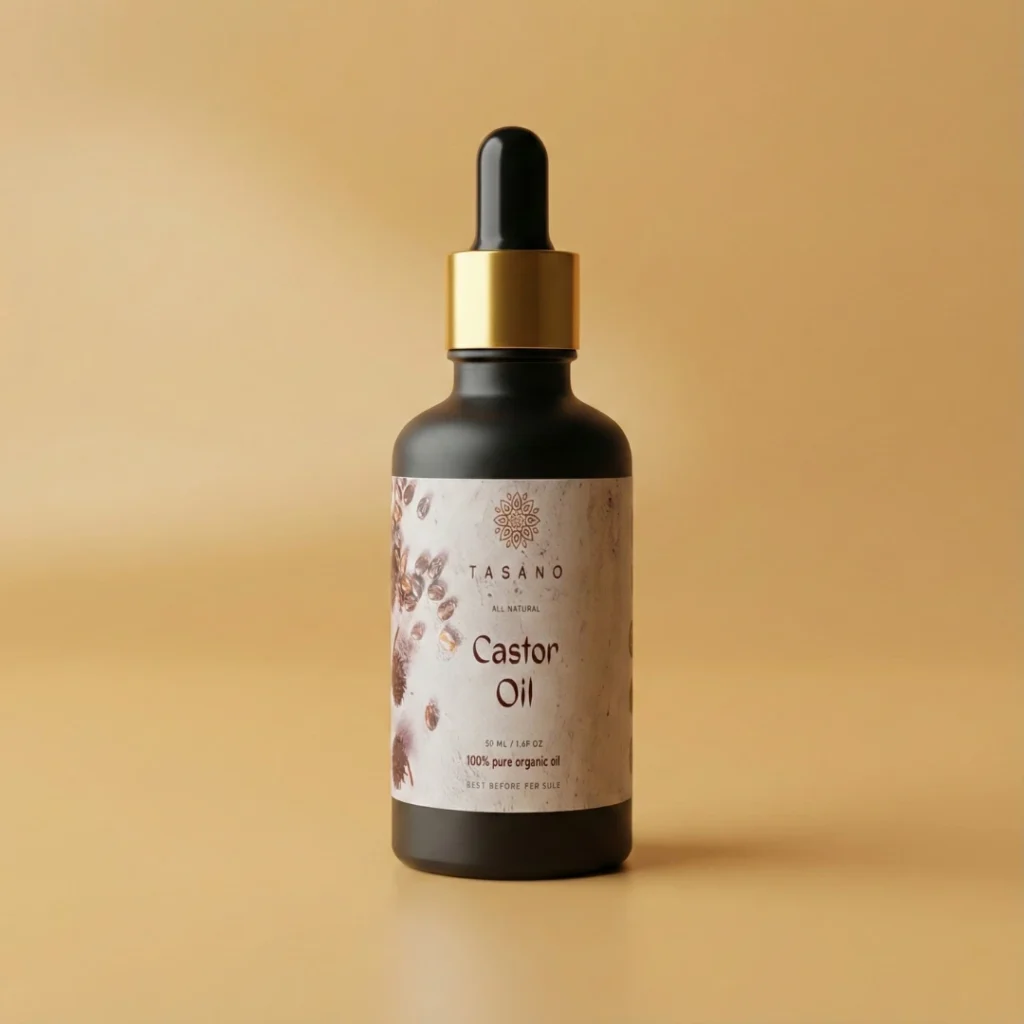
- Castor oil for richer conditioning and breakage-prone ends
Argan oil for hair growth is often combined with scalp-focused oils for a more complete routine.
If your hair needs a heavier strengthening step, read Castor Oil for Hair: Benefits, Growth and How to Use It Properly.
How to Use Argan Oil for Hair Growth Goals
To use argan oil for hair growth goals, focus on preventing breakage and protecting the lengths.
1. Use it on damp hair after washing
After washing, towel-dry the hair until it is damp. Warm 1 to 4 drops of argan oil between your palms and apply through the mid-lengths and ends.
This helps reduce roughness, improve shine and make the hair easier to style.
Argan oil for hair growth fits naturally into routines that prioritize softness, shine, and reduced damage.
2. Use it on dry ends between wash days
If the ends look dull or feel rough, apply a small amount of argan oil to the ends only. This helps keep the oldest part of the hair from becoming brittle between washes.
3. Use it before detangling
If your hair tangles easily, apply a tiny amount before gentle detangling. This can improve slip and reduce pulling.
4. Use it as a pre-wash treatment
For very dry hair, apply argan oil to the lengths and ends 30 minutes before washing. Cleveland Clinic notes that hair oils can be applied to the ends and washed out after several hours, and that a little goes a long way.
5. Do not overload the scalp
Argan oil can be used on a dry scalp in some cases, but it should not be treated as the main growth oil. If scalp care is your concern, read Argan Oil for Scalp: Dry Scalp, Dandruff and Scalp Care Benefits.
How Often Should You Use Argan Oil for Hair Growth Goals?
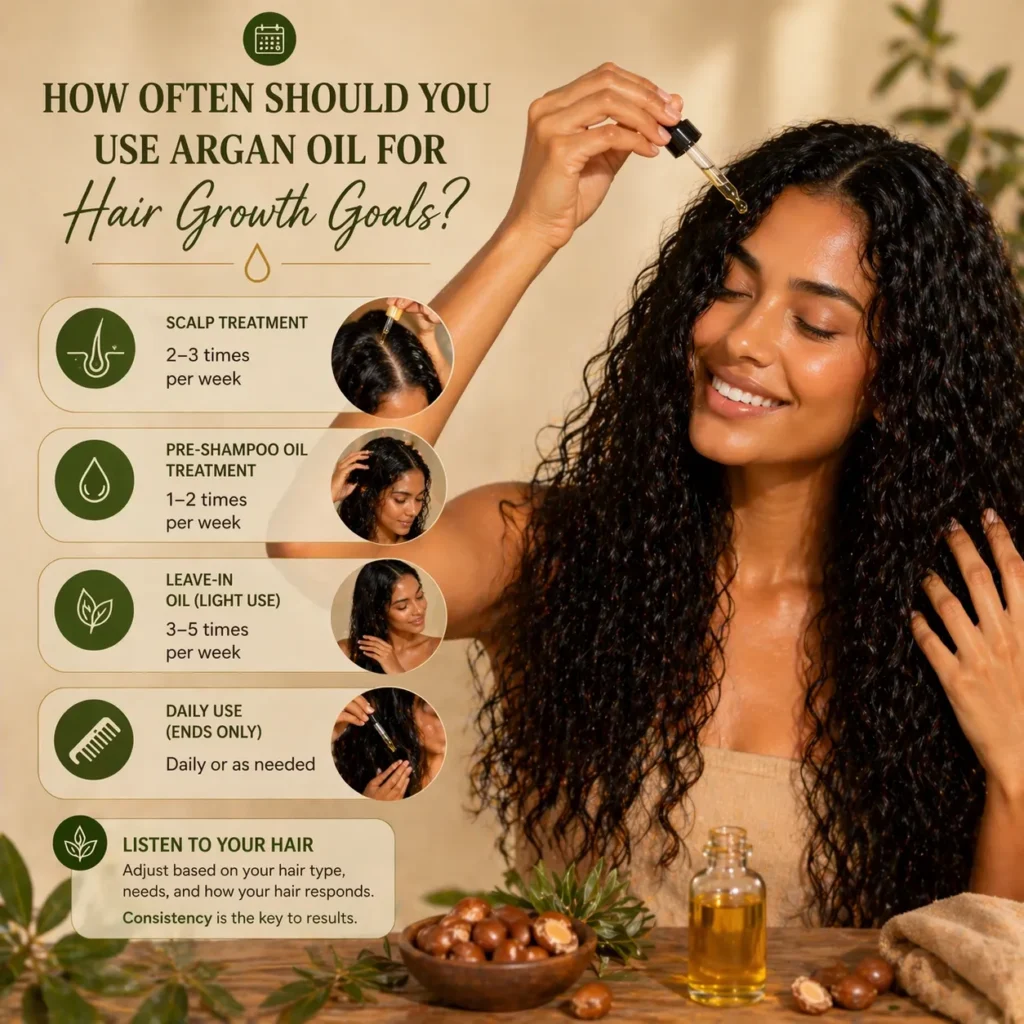
Most people can use a small amount on the lengths and ends daily or every other day. A deeper pre-wash treatment once or twice a week may help if the hair is very dry.
The best frequency depends on hair type:
- Fine hair: use less, mainly on ends
- Medium hair: a few drops after washing or between wash days
- Thick, curly or dry hair: more frequent use may be useful
- Very dry or damaged hair: combine light daily use with weekly pre-wash treatment
If the hair looks greasy, flat or heavy, reduce the amount. More oil does not mean more growth.
For argan oil in Moroccan beauty beyond hair, explore Moroccan Beauty Products: The Complete Guide to Glowing, Clear, and Youthful Skin.
Argan Oil for Hair Growth by Hair Type
- Fine hair
Fine hair can benefit from argan oil, but too much will flatten it quickly. Use 1 drop on the ends and avoid the roots.
- Thick hair
Thick hair often handles argan oil well because the lengths need more softness and control. Apply to mid-lengths and ends.
- Curly or textured hair
Curly and textured hair often struggles with dryness, tangling and breakage, which makes argan oil useful for length retention. It can help soften the hair and reduce frizz without destroying movement when used correctly.
For a curl-specific routine, read How to Use Moroccan Argan Oil for Curly Hair.
- Damaged or color-treated hair
Argan oil is especially useful for hair that feels rough from heat or chemical stress. Cleveland Clinic notes that argan oil can help strengthen hair damaged by heat or chemicals by adding a protective layer.
Common Mistakes to Avoid
- Expecting argan oil to regrow hair
This is the biggest mistake. Argan oil supports hair condition and length retention. It is not a proven regrowth treatment.
- Applying too much oil
Too much argan oil can make hair greasy and heavy. Use the smallest amount that gives softness and shine.
- Ignoring the scalp when growth is the real concern
If your concern is thinning or reduced density, the scalp needs targeted attention. Argan oil alone is not enough.
- Using low-quality “Moroccan oil” blends
Some products marketed as Moroccan oil contain very little meaningful argan oil. If the ingredient list is vague or dominated by silicones, you may not be getting what you think.
To avoid weak formulas, read How to Choose Pure Argan Oil for Hair and Avoid Fake Moroccan Oil Blends.
- Waiting too long to address serious hair loss
If shedding is sudden, patchy, severe or progressive, get proper guidance. The AAD emphasizes that diagnosing the cause is the first step in effective treatment.
Argan Oil and Hair Growth Backed by Honest Hair Science
Argan oil is valuable for hair growth goals when it is understood correctly. The Cleveland Clinic notes that argan oil can add a protective layer to the hair and help strengthen hair damaged by heat or chemicals, while its broader hair-oiling guidance explains how oils can help moisturize hair and improve softness when used properly.
PubMed Central reviews describe argan oil as rich in fatty acids, tocopherols, polyphenols and other bioactive compounds, which helps explain its role in cosmetic care and hair-conditioning rituals. At the same time, the American Academy of Dermatology makes clear that hair loss has many causes and that effective treatment begins with identifying the cause.
For scalp-focused growth support, rosemary oil has stronger direct relevance in the literature, including the widely cited PubMed trial comparing rosemary oil with 2% minoxidil over six months. The honest conclusion is simple: argan oil can support length retention and healthier-looking hair, but rosemary oil is the stronger choice when the goal is true scalp-focused growth.
Choosing Authentic Argan Oil for Peace of Mind
When your goal is healthier-looking growth, the quality of the oil matters. A low-quality blend can leave the hair coated without giving you the clean, nourishing feel that makes argan oil valuable.
Look for:
- clear ingredient transparency
- 100% pure argan oil or clearly argan-rich formulas
- packaging that protects the oil from light and oxidation
- fresh texture and scent
- transparency about Moroccan origin
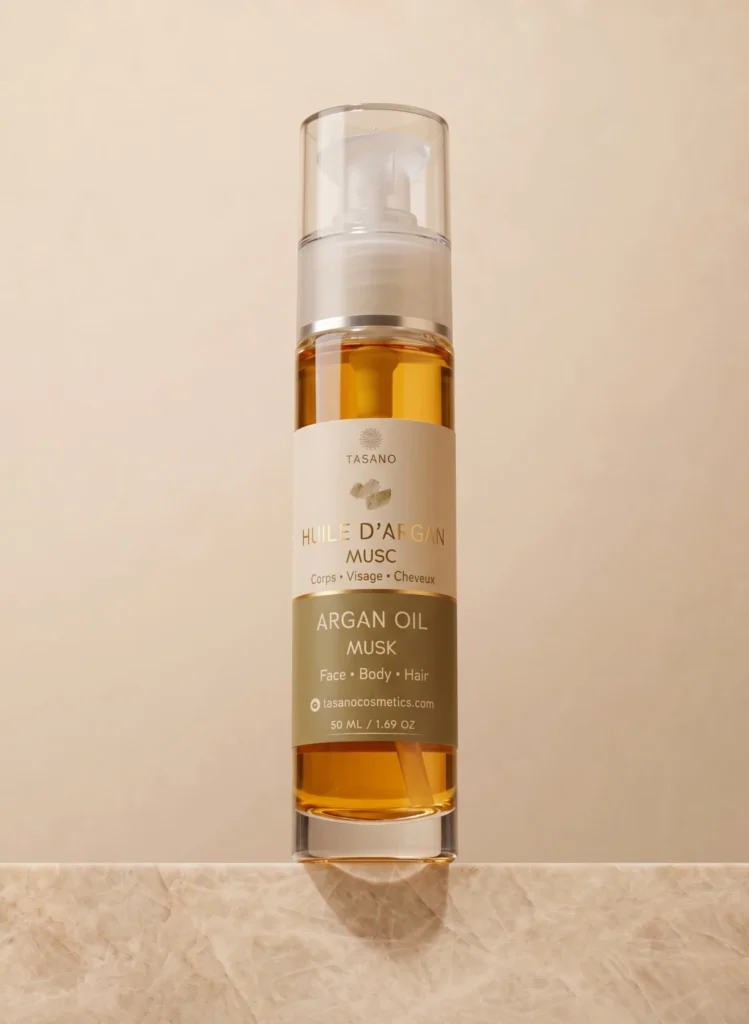
For readers who want confidence in what they are applying, TASANO’s 100% Pure Moroccan Argan Oil offers an authentic option for softness, shine, dry ends and length-retention routines. It fits naturally into daily use, pre-wash rituals and breakage-conscious hair care.
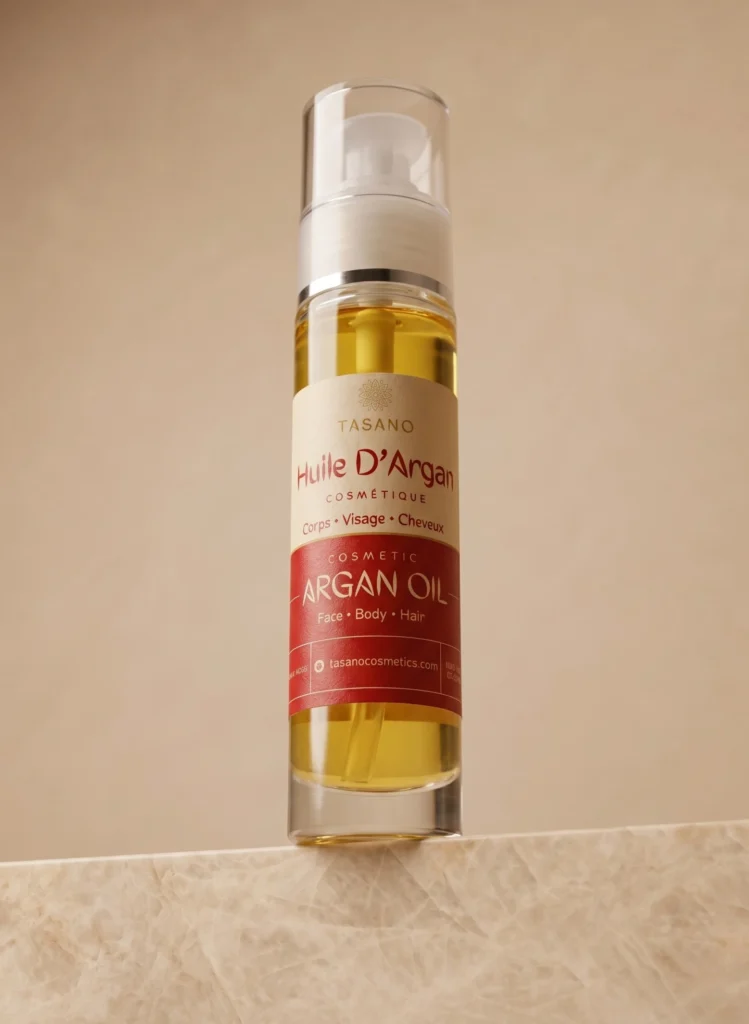
100% Pure Moroccan Argan Oil
A lightweight, cold-pressed Moroccan argan oil for face, hair, body, nails, and beard care. Designed to soften dry-feeling skin, smooth the look of frizz, nourish dry ends, and leave a clean satin glow.
- 100% pure single-ingredient formula
- For face, hair, body, nails, and beard care
- No added fragrance, silicones, filler oils, or mineral oil
FAQ
Does argan oil help hair grow faster?
No. Argan oil is not proven to make hair grow faster. It is more useful for reducing dryness and breakage so hair can retain length better.
Is argan oil good for hair growth?
Argan oil can support hair growth goals indirectly by helping hair stay softer, smoother and less breakage-prone. It is better for length retention than direct growth.
Can argan oil help with hair loss?
Argan oil is not a hair-loss treatment. If hair loss is caused by dryness and breakage, it may help the hair look fuller over time by reducing breakage. If hair loss is genetic, hormonal or medical, proper diagnosis matters.
Should I put argan oil on my scalp for growth?
Argan oil is not the strongest scalp oil for growth. It may help dry scalp comfort in some cases, but rosemary oil is usually the stronger natural option for scalp-focused growth routines.
What oil is better than argan oil for hair growth?
Rosemary oil is usually the better choice for scalp-focused growth support. Castor oil may help with richer conditioning and breakage-prone ends, but it is also not a proven regrowth treatment.
How often should I use argan oil for hair growth goals?
Use a small amount on the lengths and ends daily or every other day, and a deeper pre-wash treatment once or twice weekly if the hair is dry.
Can argan oil make hair thicker?
Argan oil can make hair look smoother, shinier and healthier, which may make it appear fuller. But it does not physically increase the number of hairs growing from the scalp.
Final Thoughts
Argan oil can help with hair growth goals, but not in the way many people imagine.
It does not force follicles to produce hair faster. It does not reverse every kind of hair loss. And it should not be treated like a miracle growth oil.
Its real strength is more practical: it helps protect the lengths, soften dry hair, reduce roughness, improve manageability and support better length retention. For many people, that is exactly what their “growth problem” actually needs.
Use argan oil where it performs best: on the hair you are trying to keep. Use rosemary oil where growth begins: on the scalp. That combination is far more intelligent than expecting one oil to do everything.
Recommended products